How to Make a Remote Control Boat Trailer — A Step-by-Step DIY Guide
Most hobbyists learn how to make a remote control boat trailer the first time a hull outgrows the trunk of a car or the bed of a hatchback. A 30-plus-inch mono hull, its stand, a battery box and a tackle box of spare props do not fit neatly anywhere once the boat grows past entry-level size, and a dedicated trailer solves that without needing a full-size truck. This guide walks through a basic DIY RC boat trailer build from materials to tie-down, sized for whatever hull is actually sitting in the garage rather than a one-size-fits-all template.
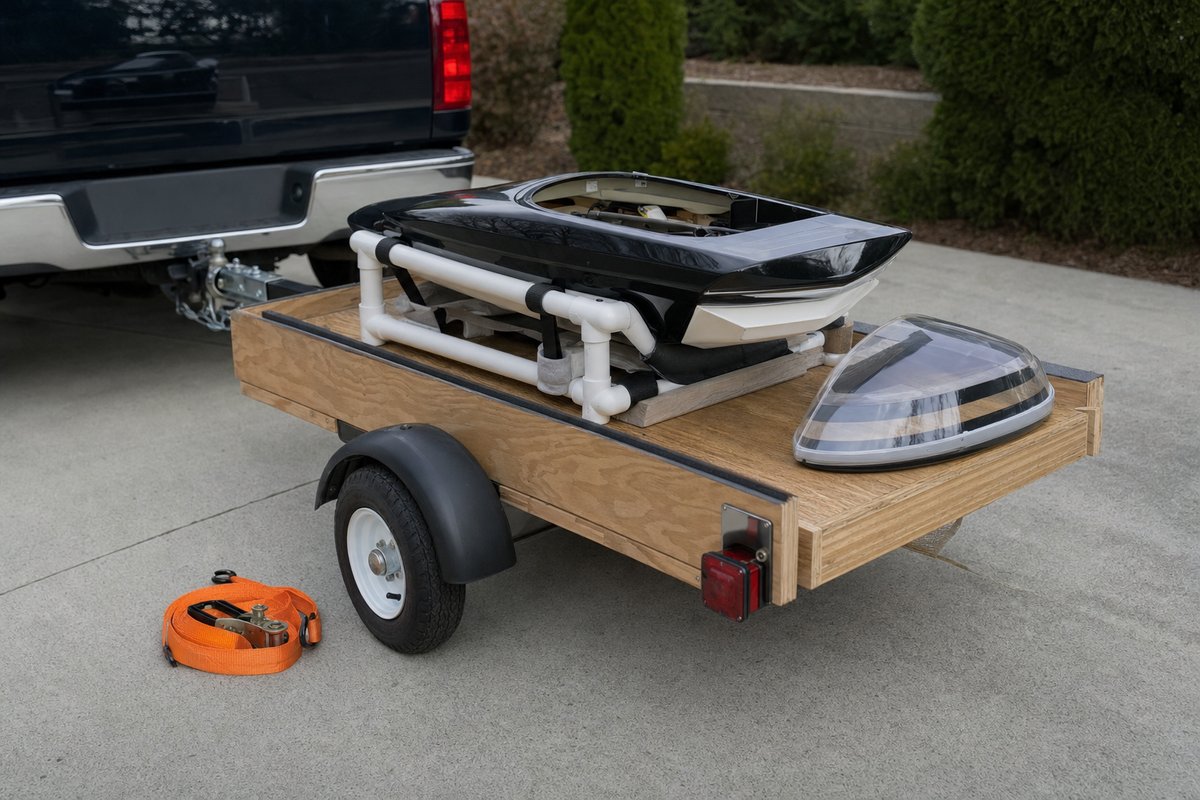
Materials for a DIY RC Boat Trailer Build
A functional DIY RC boat trailer does not require welding, a metal shop, or specialty parts most hardware stores lack. The core materials list is short: exterior-grade plywood for the deck and side walls, a length of PVC pipe cut into rollers for the hull cradle, a bolt-on trailer axle with matched wheels, carriage bolts and washers for assembly, and several ratchet or cam-buckle tie-down straps. Marine-grade plywood costs more up front but shrugs off the moisture that comes with storing a boat trailer near water, which matters more than it seems the first time a cheaper sheet starts delaminating at the edges.
Padding matters just as much as structure. Strips of old carpet, foam pipe insulation, or closed-cell foam glued over every point the hull actually contacts (cradle rails, PVC rollers, deck edges) prevent scuffed gelcoat or dented foam over repeated loading cycles. A hull that costs several hundred dollars deserves a few dollars of padding rather than bare wood or PVC against its hull sides.
Tool-wise, this build stays well within a basic home workshop. A circular saw or jigsaw handles the plywood cuts, a drill with a socket adapter sets the carriage bolts through the axle mount, and a hand or power sander knocks down sharp plywood edges before anything gets painted or sealed. A tape measure and a square matter more than any power tool on this list, since a deck cut a half-inch out of square telegraphs into a cradle that never sits quite right no matter how carefully the rest of the build goes.
How to Make a Remote Control Boat Trailer: Step-by-Step Build
Start with the deck. Cut a plywood base sized a few inches longer than the hull to leave room for bow and stern tie-down points, then bolt on side rails tall enough to keep the cradle supports rigid under load. Next, mount the axle assembly underneath the deck's center of gravity (slightly aft of center if the hull's stand or battery box will sit toward the bow) and attach the wheels. Building the cradle comes third: two or more padded V-shaped supports, spaced to match the hull's hull-to-keel taper, holding the boat at the same angle it naturally rests at rather than forcing it flat.
With the frame, axle and cradle in place, add a tow handle or hitch point sized to how the trailer will actually move: a simple loop handle for hand-pulling short distances, or a proper coupler if it will ride behind a vehicle on a longer trip. Finish with tie-down anchor points bolted through the deck near the bow and stern, not just screwed into the plywood surface, since a screw alone will eventually pull loose under repeated strap tension. The full sequence below breaks each of these steps down further, and the labeled diagram in this guide shows how the finished pieces fit together.
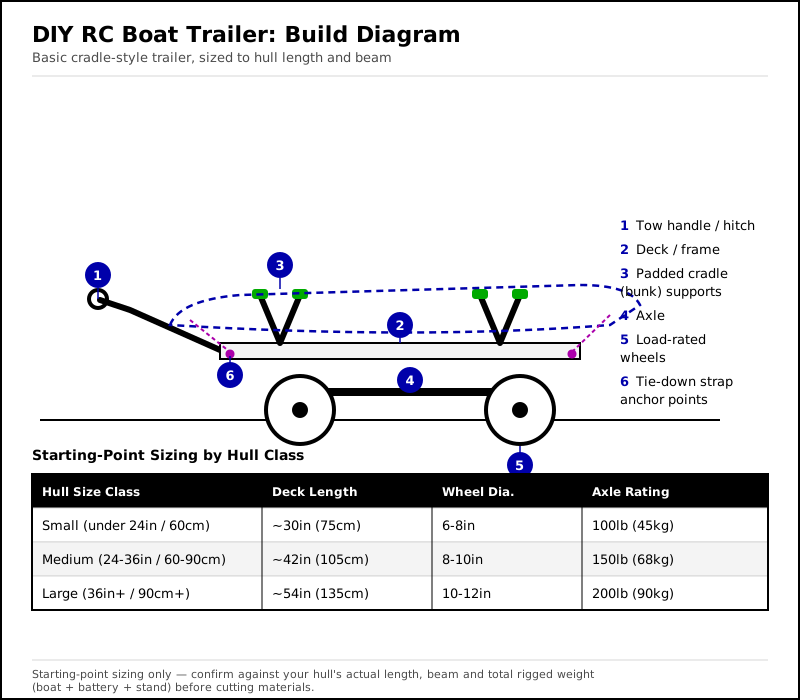
Sizing the Trailer Deck and Cradle by Boat Size
Deck length should track hull length with a margin, not match it exactly. A hull under 24 inches sits comfortably on roughly a 30-inch deck; a 24-to-36-inch hull needs closer to 42 inches; anything 36 inches and up is more comfortable on a 54-inch-plus deck with room to spare at both ends for tie-down anchors. Deck width only needs to clear the hull's beam plus the thickness of the cradle rails on either side. There is little benefit to building it wider than that, since extra width just adds unneeded weight and material cost.
Cradle spacing follows hull shape more than hull length. A deep-vee planing hull needs cradle supports angled to match its deadrise, while a flatter mono hull tolerates a shallower cradle angle without rocking side to side. Testing the fit with the hull resting in place, unloaded, before any straps go on, catches a mismatched cradle angle before it becomes a permanent wobble every time the boat is loaded.
Dry-fit the hull in the cradle before drilling a single tie-down anchor hole. A cradle angle that looks close on paper often needs a half-inch adjustment once real weight settles into it, and it is far easier to reposition unbolted cradle rails than to fill and redrill anchor holes after the fact.
Choosing Axle and Wheel Sizes for the Load
Axle and wheel selection comes down to total rigged weight, not hull length alone. Add the hull's dry weight, the battery pack or packs, any onboard stand, and a reasonable safety margin, since an axle rated only for the boat itself will be under-spec the moment gear gets loaded alongside it. Most hobby-scale builds land comfortably under 100 to 200 pounds all-in, but sizing to that real number rather than a guess is what actually prevents a bent axle or blown bearing down the road.
Wheel diameter should scale with trailer size and the surfaces it will roll over. Small trailers built for hulls under 24 inches run fine on 6 to 8 inch wheels; larger trailers carrying 36-inch-plus hulls ride noticeably smoother on 10 to 12 inch wheels, especially over gravel boat-ramp parking lots and uneven grass. A wheel that is technically rated for the load but too small in diameter still transmits more shock into the frame than a properly sized one.
Securing the Hull for Transport
Padded cradle supports handle most of the lateral stability on their own, but two tie-down straps — one near the bow, one near the stern — are what actually keep the hull from bouncing loose over a rough road. Route each strap over a structural point on the hull, such as a molded rub rail or a reinforced deck edge, never across a canopy or hatch cover, since a tight strap over a thin hatch can crack it well before the trailer reaches its destination.
A trailer built without waterproofed electronics in mind can still transport a hull safely, but anyone running a sealed ESC setup should give the hatch a final check before loading, since a loose hatch gasket noticed on the trailer is far easier to fix than one discovered lakeside. Motor sizing decisions made for the hull, detailed separately in our brushless motor sizing guide, also affect the trailer's total load number, so it is worth finalizing the power system before locking in an axle rating.
Common Mistakes to Avoid When You Build a Trailer
Undersizing the axle is the mistake that causes the most grief later, usually because the builder weighs the hull alone and forgets the battery, the onboard stand, and whatever gear rides along in the truck bed with it. An axle rated right at the hull's dry weight has zero margin left the first time a second battery or a heavier stand gets added to the loadout, and bearings fail well before the axle itself bends. Skipping the dry-fit before drilling anchor holes is a close second: a cradle angle that looks correct on the workbench often needs a small adjustment once the hull's real weight settles into it, and predrilled holes in the wrong spot are far more annoying to fix than an unbolted rail that just needed repositioning.
A few smaller mistakes show up just as often. Sealing plywood only on the top face and skipping the underside lets moisture wick in from below, which warps a deck long before the visible surface shows any wear. Anyone towing behind a vehicle on public roads should also confirm the trailer has working lights if local law requires them. This is easy to overlook on a small trailer that feels more like an accessory than a real towed vehicle, but it is a real requirement in most places once the trailer goes on a public road rather than staying in a driveway or at the boat ramp. And leaving a finished trailer uncovered outdoors year-round accelerates UV damage to plywood and straps alike; a basic tarp during the off-season adds years to a build that otherwise took a full weekend to finish.
Maintenance, Storage and a Quick Buyer's Guide for Ready-Made Trailers
A wood-and-PVC trailer needs little upkeep beyond periodic bolt checks and reapplying exterior sealant to the plywood once a season, especially if it lives outdoors near water. Folding or removing the tow handle for storage, where the design allows it, saves real floor space in a garage or shed, and a bolted rather than welded tongue joint makes that retrofit simple even on an already-finished build. For hobbyists who would rather buy than build, small pre-made utility trailers sized for kayaks or paddleboards often adapt well to an RC hull with a swapped-in cradle, and this guide's sizing numbers above apply just as well to picking one of those off the shelf as to a from-scratch build. Reading through a few published rc boat trailer plans from other builders before finalizing dimensions, even when building custom, tends to catch sizing mistakes that only show up once a trailer is loaded for the first time.
Hull type also shapes the finished trailer more than it might seem at first. Deep-vee offshore-style hulls need different cradle geometry than flat-bottom or catamaran designs, and matching that geometry up front avoids rebuilding the cradle after the fact. Everything else in RC boat setup and maintenance, including motor sizing, ESC protection and battery selection, is covered across our boats section for anyone working through a full build rather than the trailer alone. Whatever route gets there, knowing how to make a remote control boat trailer that actually matches the hull in hand, rather than a generic template sized for someone else's boat, is what keeps the trip to the water uneventful.
Frequently Asked Questions
What materials do I need to build an RC boat trailer?
A basic build needs exterior-grade plywood for the deck and side rails, PVC pipe cut into short rollers for the cradle, a pre-made trailer axle with wheels rated for the combined weight, carriage bolts and washers, and a handful of ratchet or cam-buckle tie-down straps. Marine-grade plywood costs more but resists moisture better if the trailer will sit outdoors near water most of the season.
How to make a remote control boat trailer without welding?
Skip metal fabrication entirely by building the frame from plywood and dimensional lumber, joined with carriage bolts, wood screws and construction adhesive instead of welded joints. A bolt-together plywood frame is plenty strong for the light weight of a hobby-scale hull, and it is far more accessible for anyone without welding equipment or experience.
What size trailer deck does my RC boat need?
Deck length should run a few inches longer than the hull itself to leave room for the bow and stern tie-down points, so a 24-inch hull is comfortable on a roughly 30-inch deck, while a 40-inch hull needs closer to 48 to 54 inches of usable deck length. Deck width only needs to clear the hull's beam plus the width of the cradle supports on either side.
What wheel size should an RC boat trailer use?
Small trailers built for hulls under 24 inches typically run fine on 6 to 8 inch wheels, while larger trailers carrying 36-inch-plus hulls do better with 10 to 12 inch wheels for a smoother ride over gravel or uneven ground. Matching wheel size to the trailer's actual load, not just the boat's length, avoids premature bearing or tire wear.
How do I keep the hull from shifting during transport?
Padded cradle supports shaped to the hull's deadrise angle stop most side-to-side movement on their own, and two tie-down straps, one near the bow and one near the stern, handle the rest. Route straps over structural points on the hull rather than across the canopy or hatch, since a tight strap on a thin hatch cover can crack it on a rough road.
Can I use PVC pipe for the trailer's cradle rollers?
Yes, PVC pipe sleeved over a bolt or steel rod axle makes a simple, low-cost roller that lets the hull slide on and off the trailer without scraping the deck. Wrapping the PVC in a strip of old carpet or foam pipe insulation before mounting it adds cushioning that plain PVC alone does not provide.
Do I need a license plate or registration for a small RC boat trailer?
Requirements vary significantly by state and by the trailer's total weight, so checking local DMV rules before towing on public roads is worth the ten minutes it takes. Many very small, lightweight utility trailers fall under a registration exemption threshold, but that threshold is set locally, not nationally, so it is never safe to assume.
How much weight does a typical RC boat trailer need to carry?
Add the hull's dry weight, the battery pack, any onboard stand or transport box, and a safety margin, since it is the total rigged weight rather than the hull alone that the axle and wheels need to handle. Most hobby-scale builds stay well under 100 to 200 pounds total, but sizing the axle to that real number rather than guessing avoids a wheel or bearing failure later.
What is the fastest way to build a DIY RC boat trailer over a weekend?
Buying a pre-made small utility trailer axle-and-wheel kit and building only the plywood deck, cradle and tie-down points around it cuts the build down to a single weekend for most hobbyists, since the axle assembly is the most time-consuming part to fabricate from scratch. Pre-cut PVC rollers and pre-drilled deck plywood from a hardware store shave off additional time.
Are there ready-made RC boat trailer plans available online?
Yes, RC boat forums and hobby-club build logs frequently publish rc boat trailer plans with specific cut lists and photos of finished builds, which are worth searching out before buying materials, since seeing a working example first prevents sizing mistakes that only show up once the trailer is loaded.
How do I protect the hull's paint from scratches on the trailer?
Line every surface the hull actually touches, including cradle supports, PVC rollers and any deck contact points, with closed-cell foam, old carpet scraps or pipe insulation, since bare wood or PVC will scuff gelcoat and painted foam over repeated loading cycles. A few dollars of padding material protects a hull that likely cost far more than the trailer itself.
Should the trailer tongue be removable for storage?
A removable or foldable tongue is a worthwhile add for anyone storing the trailer in a garage or shed with limited floor space, since a fixed rigid tongue can add a foot or more to the trailer's stored footprint. A bolted, rather than welded, tongue joint makes this easy to build in from the start rather than retrofitting it later.
How do I keep water from pooling on the trailer deck?
Drill a few small drainage holes through the lowest points of the deck, and pitch the deck very slightly toward those holes if the design allows it, so rainwater or hose-off runoff drains rather than sitting against the plywood and accelerating rot at the seams even on a sealed surface.
Should I use galvanized or stainless hardware for the trailer build?
Stainless steel bolts and washers resist corrosion better than galvanized hardware over years of outdoor storage near water, though galvanized hardware costs meaningfully less and holds up fine for a trailer stored indoors or covered between uses. For a trailer living outdoors year-round near saltwater specifically, the extra cost of stainless is usually worth it.
How wide should the trailer's axle track be relative to the deck?
The wheel track should sit close to the deck's outer edges for stability, wide enough that the loaded trailer doesn't feel tippy when cornering behind a vehicle, but not so wide that the wheels protrude past the deck and risk contact at a boat ramp or narrow storage space. Matching the axle width to a common pre-made axle assembly's stock track, rather than custom-fabricating a wider one, is the simpler and cheaper route for most builds.