RC Tools & Maintenance Guides — Adhesives, Tool Kits & Repairs
RC maintenance problems repeat across cars, boats and planes more than most owners expect: a tire that separates from its foam insert, a screw hole stripped smooth in a glass-filled nylon chassis mount, a diff that's gone gritty after a season of dirt, or a Lexan body that needs repainting after a rollover. Fixing any of these correctly depends on matching the material to the method, not on reaching for whatever adhesive is already open on the bench.
Cyanoacrylate glue, epoxy and hot glue behave very differently once heat, flex or foam enters the picture, and using the wrong one is the single most common way a repair fails a second time. A foam wing that gets standard CA instead of a foam-safe formula won't just fail to bond. It can eat a visible crater into the airframe. A stripped screw hole patched with the wrong filler backs out again within a few runs. Tool selection follows the same logic: a hex driver set sized for 1/10-scale hardware won't necessarily cover a larger monster truck's fasteners, and a diff grease pulled from an automotive shelf isn't formulated for the heat and shear an RC differential sees.
This section works through the adhesive comparisons, tool-kit choices and hardware fixes that come up most often once a vehicle has logged more than a few outings: glue selection by material, what actually belongs in a maintenance kit, and the specific repairs (stripped holes, seized set screws, worn grease) that separate a vehicle still running well from one quietly falling apart.
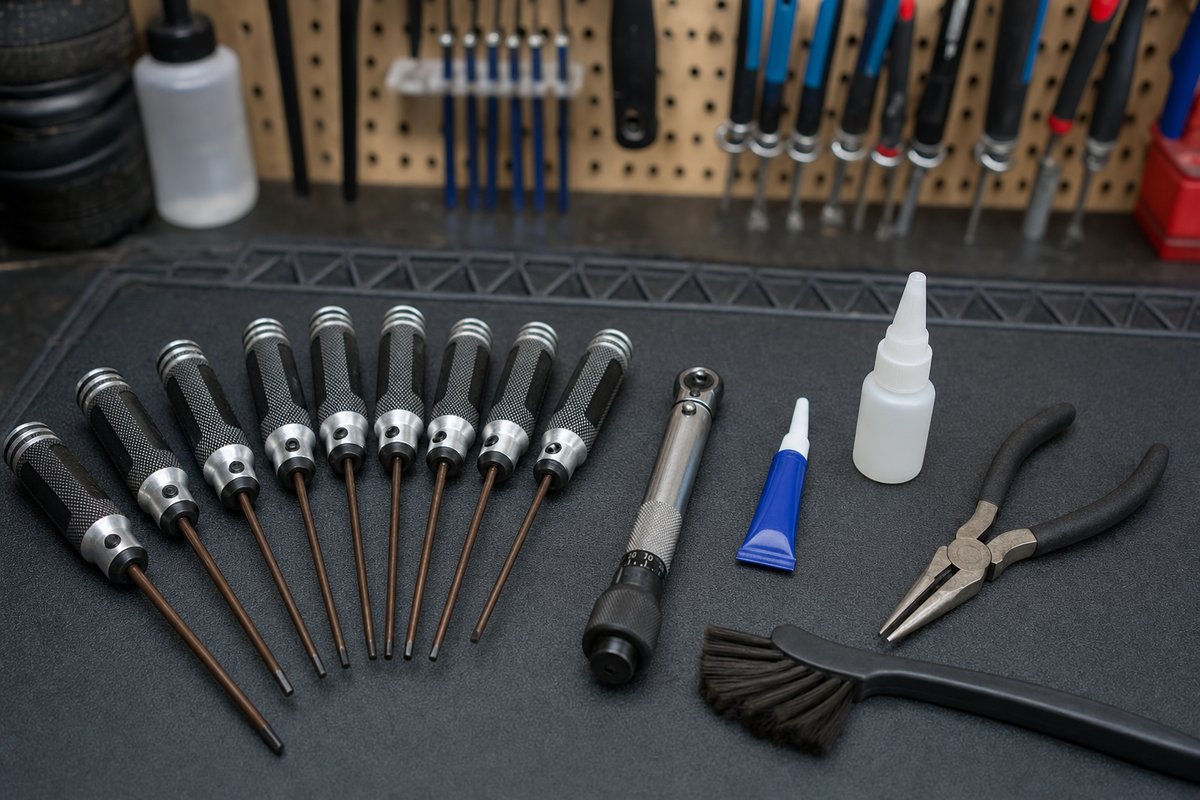
Cyanoacrylate glue cures through moisture in the surrounding air rather than through the surface it's applied to. That's why a thin CA bead at a tire seam sets in seconds, while a thicker gap-filling CA joint takes noticeably longer, since trapped air in the middle of the joint has less moisture exposure to trigger the cure.
Guides in This Section
Best Glue for RC Tires
Which tire-gluing CA formulas hold up under hard cornering without attacking the rubber compound.
How to Fix a Stripped Screw Hole in Plastic
Repacking and re-threading a stripped chassis mount, plus when a heat-set insert is the better fix.
Best Grease for RC Cars
Silicone diff grease versus general bearing grease, and where each one belongs on a chassis.
Best RC Tool Kit
What a starter kit needs versus what only gets added once builds get more involved.
Best RC Hex Driver Set
Metric hex sizes that actually cover 1/10-scale hardware, and where sets fall short on larger trucks.
Gorilla Glue vs. Epoxy
Cure time, gap-filling and shear strength compared for structural chassis repairs.
What tools does a basic RC maintenance kit actually need?
A functional kit covers a metric hex driver set (1.5mm to 3mm covers most cars and trucks), a set of small Phillips and flathead screwdrivers, needle-nose pliers, a hobby knife, thread-lock, and at least one general-purpose CA glue. Bearing pullers and a nut driver set get added once a build gets more involved.
What glue works best on RC tires?
Thin CA glue formulated for tire gluing is the standard choice: it wicks into the seam between the tire and the foam insert or wheel and cures fast without eating into rubber compound. Contact cement is a slower-curing alternative some racers prefer for its flex.
Can epoxy replace CA glue for chassis repairs?
For structural chassis cracks and mounting-point repairs, yes: epoxy has better gap-filling and shear strength than CA and doesn't go brittle the way cured CA can. CA remains faster for small, tight-fitting joints where clamping isn't practical.
How do you fix a stripped screw hole in a plastic chassis part?
The common shop fix is to pack the hole with a few strands of CA-soaked scrap plastic or a toothpick fragment, let it cure, then re-thread the screw while it's still slightly soft. For a hole that's stripped beyond that, a heat-set threaded insert gives a permanent repair on glass-filled nylon parts.
What's the safest glue to use on foam RC airframes?
EPO and EPP foam react badly to standard CA and many solvent-based adhesives, which melt the foam's cell structure. Foam-safe CA (often labeled for foam or RC aircraft use) and foam-safe epoxy are formulated to avoid that reaction; regular hobby CA should be tested on scrap foam first.
How often should RC bearings and diff gears be greased?
Bashers running in dirt or sand benefit from a diff and bearing check every few outings, since grit works past seals faster than most owners expect. On-road or indoor use stretches that interval considerably; a visual check for dried-out or gritty grease is a better signal than a fixed schedule.
What hex driver sizes cover most RC hardware?
Most 1/10-scale cars and trucks use metric hex hardware between 1.5mm and 3mm, with 2mm and 2.5mm covering the bulk of shock caps, wheel hex screws and body mounts. A set that also includes a 5.5mm or 7mm nut driver handles wheel nuts and turnbuckles.
Why won't hot glue hold on certain RC parts?
Hot glue bonds poorly to low-surface-energy plastics like polypropylene and to anything oily, greasy or dusty, all common on RC chassis parts near drivetrains. It also softens under heat near motors and ESCs, which makes it a weak choice for anything close to a heat source.
How do you remove a stuck or rounded set screw without a screw extractor kit?
A rubber band pressed between the driver tip and the rounded screw head adds grip and often gets enough bite to back it out. Heating the screw briefly to break down thread-lock, or tapping a slightly oversized flathead bit into the rounded slot, are the next steps if that doesn't work.
What paint works on Lexan or polycarbonate RC bodies?
Polycarbonate-specific paint applied to the inside of a clear body is the standard approach: it's formulated to flex with the material instead of cracking on impact, unlike most general hobby or spray-can paints applied to the outside.
Is silicone grease safe for RC diff gears?
Silicone-based diff grease is the correct choice for gear differentials — it maintains viscosity and resists getting flung out under heat and centrifugal load better than a generic lithium grease. It should not be substituted with silicone diff fluid, which serves a different, thinner-viscosity role in fluid-filled diffs.
What's a reasonable alternative to dedicated RC tire glue?
Shoe-Goo-style flexible adhesives and some contact cements can hold a tire bead in a pinch, though cure time runs longer and the bond tends to be less durable under hard cornering loads. Dedicated thin CA remains the more reliable option for anything raced regularly.