RC Battery & Power System Guides — LiPo, Connectors, ESCs & Chargers
LiPo chemistry runs almost every modern RC vehicle, and the Batteries & Power section covers what the specs on a pack label actually mean along with the connector and ESC choices tied to them. A pack rated 4S 5000mAh 60C isn't self-explanatory: cell count sets voltage, capacity sets run time, and the C-rating sets the theoretical maximum continuous discharge current, which matters more than most builders realize when it's paired with an ESC that can't handle that current on the output side.
Connector choice is its own decision, not an afterthought. XT30, XT60 and XT90 bullet connectors are rated for different continuous-amp loads, and using an XT30 on a 6S pack pulling real current is a common way to melt a connector housing mid-run, not a rare edge case.
ESC troubleshooting sits alongside battery care because the two systems fail together almost as often as they fail separately: a blinking status light on an ESC can point back to a battery problem just as often as it points to a wiring or programming issue. This section also covers LiPo storage voltage, safe charging without a dedicated balance charger, and the freezer-revival trick that sometimes brings an old NiMH pack back for one more season.
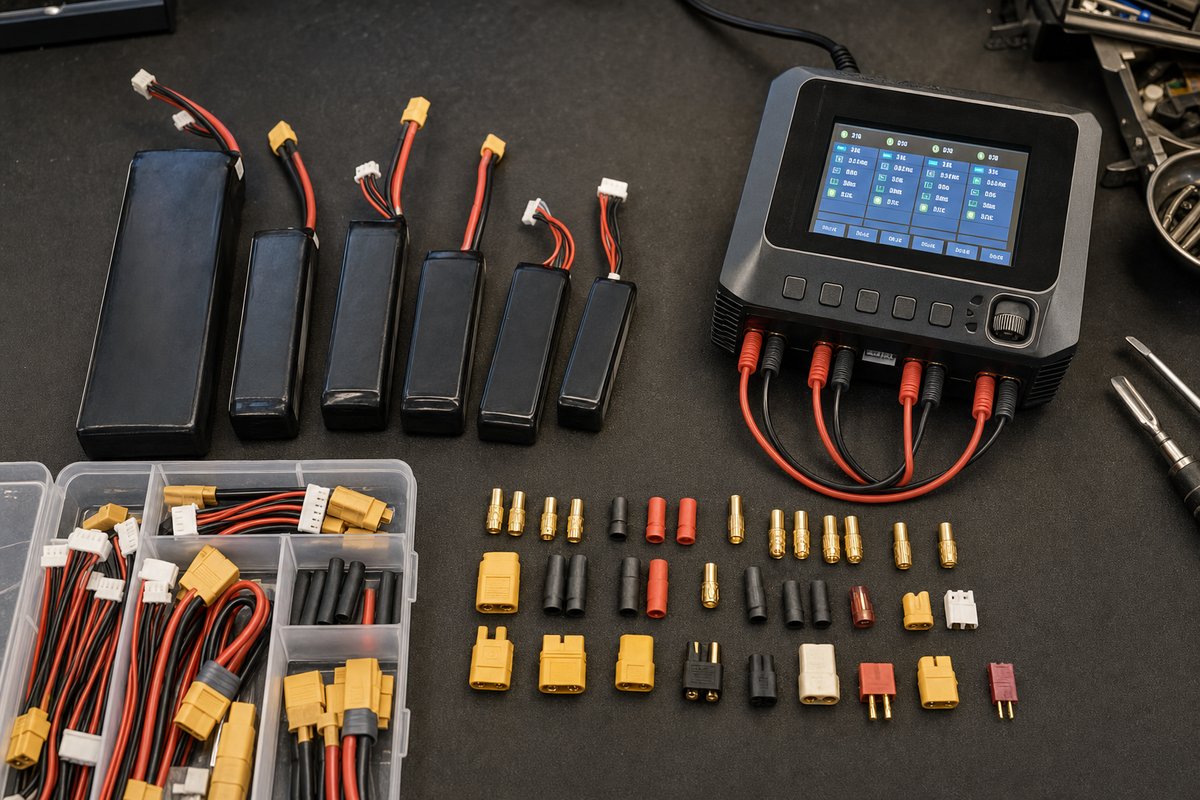
Guides in This Section
C2 vs C4 Battery Ratings Explained
What the C2 vs C4 discharge-rate labeling actually means for max continuous amp draw.
How to Charge a LiPo Battery Without a Charger
Safe and unsafe methods for topping off a LiPo pack when a proper balance charger isn't available.
XT30 vs XT60 Connectors
Current rating and physical size differences between XT30 and XT60 bullet connectors.
XT60 vs XT90 Connectors
When a pack needs the higher continuous-amp headroom of XT90 over XT60.
Best ESC for RC Cars
Matching ESC amp rating and BEC output to motor size and receiver load.
How to Discharge a LiPo Battery for Storage
Bringing a pack down to storage voltage safely between sessions.
Graphene Battery vs. LiPo
What the graphene additive actually changes inside a pack, and when the price premium is worth paying.
XT30 connectors are commonly rated around 30A continuous, XT60 around 60A, and XT90 around 90A. Those numbers assume solid solder joints and appropriately sized wire — a connector rated for 60A on paper won't safely carry that current through thin 22AWG lead wire.
What does a LiPo battery's C-rating actually mean?
The C-rating is a multiplier on capacity that estimates maximum continuous discharge current. A 5000mAh 60C pack, for example, is rated for roughly 300A continuous (5Ah x 60). Real-world safe current is usually lower once wire gauge and connector limits are factored in.
Should I use XT60 or XT90 connectors?
XT60 handles roughly 60A continuous and suits most 2S-4S packs under moderate load. XT90 is built for higher continuous current, generally 90A and up, and is the safer choice for high-C 4S-6S packs feeding power-hungry brushless systems.
Can a LiPo battery be charged without a balance charger?
A basic charger without balance leads can bring the pack up in overall voltage, but it can't correct for individual cell imbalance, which is the main safety mechanism that prevents overcharging a single cell. It's a stopgap, not a routine method.
Why is my LiPo battery swollen?
Swelling usually means gas has built up inside the cells from overcharging, over-discharging, physical damage or age-related breakdown of the internal chemistry. A puffed pack has reduced capacity and a higher failure risk and should be retired rather than depuffed and returned to regular use.
What voltage should a LiPo be stored at?
Most manufacturers recommend storing LiPo packs around 3.8V per cell (a 3S pack at roughly 11.4V total) rather than fully charged, since holding a pack at full charge for weeks accelerates capacity loss.
Why won't my LiPo battery charge?
A charger that won't recognize a pack is often reading a cell voltage outside its safe range, a damaged balance connector, or a charger set to the wrong cell count or chemistry. Checking individual cell voltages with a separate meter usually narrows down which of the three it is.
What does a blinking red light on an ESC mean?
Blink patterns vary by brand, but a repeating red blink most often signals a low-voltage cutoff, a throttle calibration issue, or a lost signal from the receiver. Checking the manual's specific blink-count table is more reliable than guessing from a general rule.
Does freezing really bring a dead NiMH battery back?
It can work on NiMH packs that have developed internal dendrites or a specific type of cell short, but it's not effective on LiPo chemistry and isn't a permanent fix even on NiMH. It buys a pack a limited number of additional cycles at reduced capacity.
How do I match an ESC to my motor?
Check that the ESC's continuous and burst amp ratings exceed what the motor will actually draw under load, that its voltage range covers your cell count, and that its BEC output can support the receiver and any servos wired to it.
What's the practical difference between XT30 and XT60 connectors?
XT30 is smaller and lighter, suited to 1S-2S packs under roughly 30A, while XT60 is larger, rated for around 60A continuous, and is the more common choice once a build moves to 3S or higher.