RC Plane and Helicopter Guides — FPV Gear, Propellers & Troubleshooting
Propulsion choice sits at the center of this section, starting with the ducted-fan-versus-propeller question that decides how a fixed-wing plane or small VTOL model actually generates thrust. From there the guides split into two working groups: fixed-wing gear, covering FPV cameras, long-range radio links and float conversions, and rotary-wing troubleshooting, covering the toy-grade helicopters that make up a large share of first helicopter purchases and fail in a handful of predictable ways.
Toy-grade helicopters like the Sky Rover and Syma S107 lines share the same short list of failure points: a battery that will not take a charge, a main rotor spinning unevenly, or a tail that will not hold heading. Diagnosing those faults correctly usually means ruling out the charging port and connector before assuming the battery pack itself is dead, and checking gearbox debris before assuming a motor has failed. Fixed-wing coverage runs in a different direction, toward camera selection for FPV flying, radio-link range for long-distance flights, and the foam-safe adhesives an EPP or EPO airframe needs after a hard landing.
A handful of entries here also track equipment history, including what happened to long-running kit lines as the hobby shifted toward foam ARF airframes. That context matters for anyone trying to source parts for an older balsa build, not just for nostalgia.
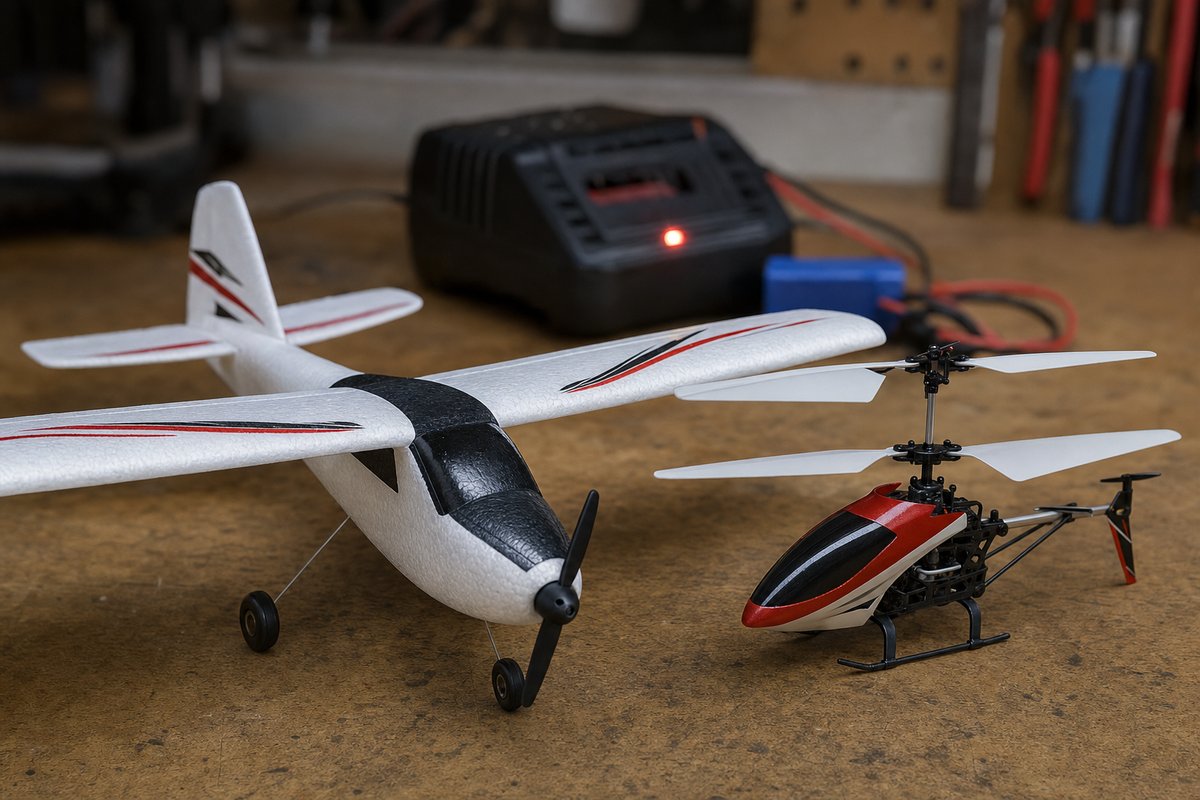
A shrouded, ducted fan generates more static thrust per horsepower at low airspeed than an open propeller of equal diameter, since the duct recovers energy from tip vortices that an open blade sheds as waste. That advantage narrows and eventually reverses as forward airspeed increases, because the duct's own weight and skin drag start costing more than the thrust gain is worth, which is exactly why open propellers still dominate cruise-speed fixed-wing flight.
Guides in This Section
Ducted Fan vs Propeller: How Each Generates Thrust
A technical comparison of shrouded ducted-fan and open-propeller thrust efficiency across low and cruise airspeeds.
Best Camera for RC Planes: FPV and Onboard Recording Picks
Camera weight, latency and low-light performance tradeoffs for mounting on park flyers and sport planes.
Sky Rover Helicopter Troubleshooting: Common Fixes
Diagnosing Sky Rover units that will not lift off, drift sideways, or lose power mid-flight.
Best Long-Range FPV Plane Setups
Airframe and radio-link combinations built to hold a stable feed well beyond typical line-of-sight range.
What Happened to Great Planes Balsa Kits
Tracking the balsa-kit line's decline as foam ARF airframes reshaped the entry-level and sport-flying market.
Best RC Float Planes and Float Conversion Kits
Dedicated floatplanes and aftermarket float sets for converting a standard trainer to water takeoffs.
Air Hogs Helicopter Won't Charge: Fault Diagnosis
Working through USB port, connector and pack faults when an Air Hogs helicopter refuses to charge.
Frequently Asked Questions
Is a ducted fan more efficient than an open propeller?
It depends on airspeed. A shrouded, ducted fan produces more static thrust per horsepower at low speed than an open propeller of the same diameter, but the duct's added weight and drag work against it as airspeed climbs, which is why most fixed-wing RC planes still use open propellers while ducted fans dominate slow, hover-heavy designs.
Why won't a toy-grade RC helicopter's battery charge?
The most common causes are a worn USB charging port, a battery connector that has lost tension, or a pack that has been over-discharged past the point the onboard charge circuit will accept it. Checking the port and connector for a loose fit before assuming the battery itself is dead saves replacing a pack that was never the problem.
What is the difference between a 3-channel and 4-channel toy helicopter?
A 3-channel model controls throttle, pitch and yaw only, using a fixed-pitch tail rotor or counter-rotating blades for stability, which makes it easier to fly indoors but limits maneuvers. A 4-channel model adds cyclic control for forward and lateral movement, giving more realistic flight at the cost of a steeper learning curve.
What glue works on EPP or EPO foam without dissolving it?
Foam-safe CA glue formulated for EPP and EPO, or a foam-safe epoxy, both bond without the melting reaction that standard solvent-based adhesives or regular CA cause on foam airframes. Testing a small offcut before gluing a visible repair area is worth the extra minute.
What does a 3-axis gyro do for a fixed-wing RC plane?
A 3-axis gyro reads pitch, roll and yaw rate and makes small, continuous control-surface corrections to counter wind gusts and unwanted drift, which flattens out a plane's flight path for a smoother, more stable feel without taking control away from the pilot.
How far can a long-range FPV plane fly on a standard radio link?
A stock 2.4GHz radio typically holds a reliable link out to a few kilometers depending on antenna placement and terrain, while dedicated long-range setups pairing a directional ground antenna with a lower-frequency, higher-power link extend that range well beyond what the plane's stock radio gear can manage.
Can a standard RC plane be converted into a float plane?
Many trainer and sport airframes accept aftermarket float sets designed for their wingspan class, provided the fuselage has enough ground clearance and the motor and control surfaces are sealed against spray. Center of gravity usually needs rechecking once the floats and their mounting struts are added, since they shift weight forward and down.
Why does a toy helicopter spin in one direction and never lift off?
On coaxial and counter-rotating designs this almost always points to one main rotor spinning slower than the other, often from a damaged blade, a worn gear, or debris in the gearbox rather than a motor or battery fault, since both rotors share the same power source.
What camera specs matter most for an RC plane FPV setup?
Sensor low-light performance and latency matter more than raw resolution for flying, since a laggy or dim feed is harder to react to than a slightly softer image. Weight also matters directly on smaller trainer and park-flyer airframes, where a heavy camera changes the plane's balance and stall speed.
Are older balsa-kit plane lines still relevant to build today?
Foam ARF (almost-ready-to-fly) planes took over most of the entry-level and sport-flying market from balsa kits over the past two decades, since they need far less build time, but original balsa kits are still flown and traded among builders who prefer the lighter airframes and traditional construction they offer.