RC Radio & Transmitter Guides — Binding, Servos & Troubleshooting
Radio problems in RC rarely come from a dead transmitter. They come from a protocol mismatch, a servo mismatched to the load it's steering, or a bind that completed but left the model memory misconfigured underneath it. Spektrum's DSM2 and DSMX, Futaba's FASST and FASSTest, and the handful of competing protocols from other brands don't cross-bind, so a receiver that seems unresponsive is often just running the wrong protocol mode rather than a hardware fault.
Servo selection follows a similar pattern of mismatch. A 1/10-scale electric buggy and a 1/5-scale gas truck put entirely different torque and speed demands on a steering servo, and a unit sized for the smaller chassis will run hot or strip its gears when dropped into the larger one. Digital versus analog matters here too: digital servos correct position far more often per second, which shows up as tighter steering response but also higher current draw on an already-loaded receiver pack.
This section covers the Spektrum-specific troubleshooting that comes up most often across the ix12, ix20 and DX6 lines, binding and protocol compatibility, and servo comparisons sorted by the vehicle class they're actually built to handle.
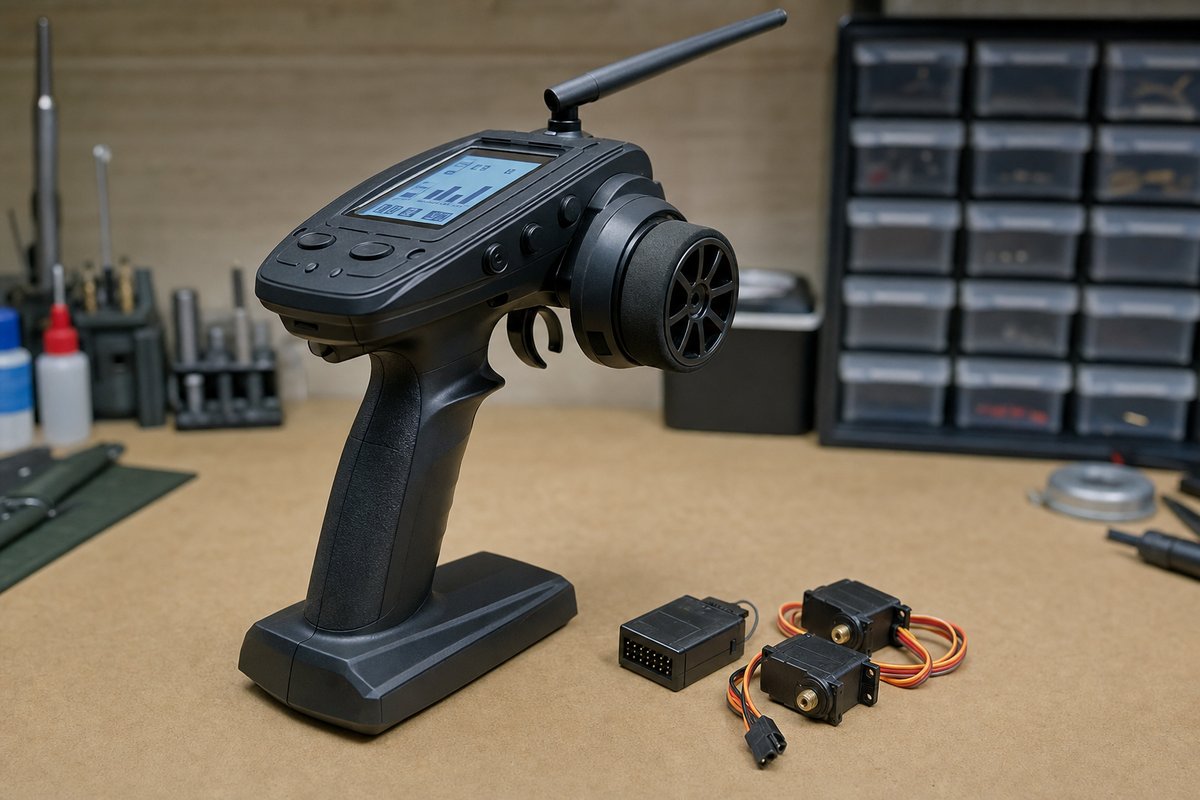
Spektrum's DSMX protocol adds frequency-hopping and channel-resiliency on top of DSM2, which is why a DSMX transmitter can bind to a DSM2-only receiver (it drops back to DSM2 behavior) but a DSM2 transmitter can never bind to a DSMX-only receiver. The compatibility only runs one direction.
Guides in This Section
Can You Bind Any Transmitter to Any Receiver
Why binding only works within a matching RF protocol, and where brand-to-brand exceptions actually exist.
Spektrum iX12 Problems
Diagnosing signal loss and failed binds on the iX12, from protocol mode to firmware sync.
Analog vs. Digital Servo
Response speed, holding torque and current draw compared for steering and throttle servos.
Best 1/5-Scale Steering Servo
Torque requirements for large-scale steering linkage and where undersized servos fall short.
Spektrum iX20 Problems
Common iX20 binding and signal complaints and the model-memory settings behind them.
Spektrum DX6 vs. DX6e
Feature and mixing differences between the full DX6 and the surface-focused DX6e.
RC Transmitter Mode 1 vs. Mode 2
What each stick layout actually controls, where the regional split came from, and which one to learn first.
Can any RC transmitter be bound to any receiver?
No. Binding only works within a matching protocol and usually within the same brand's ecosystem, such as Spektrum's DSM2/DSMX or Futaba's FASST/FASSTest. A transmitter and receiver from different protocols simply won't complete a bind, regardless of how the procedure is followed.
What's the difference between analog and digital servos?
Digital servos send correction pulses far more frequently than analog servos, which gives them faster response, more consistent holding torque under load, and finer centering — at the cost of higher current draw. Analog servos hold torque less precisely under load but draw less power and cost less.
Why does a Spektrum iX12 lose signal or fail to bind?
The most common causes are a receiver left in the wrong DSM protocol mode, a bind plug not seated before power-up, or firmware on the transmitter and receiver falling out of sync after an update. Antenna placement on the receiver end also causes intermittent signal loss that looks like a binding problem but isn't.
How much torque does a 1/5-scale steering servo need?
1/5-scale steering typically calls for a servo in the 300-400+ oz-in range, well above what a 1/10-scale car needs, because of the larger tire contact patch and heavier steering linkage. Undersized servos on 1/5-scale chassis show up as slow, mushy steering response rather than outright failure.
What causes Spektrum DX6e binding or signal problems?
DX6e issues most often trace back to a receiver bound in the wrong internal/external DSM2 or DSMX mode for the model type selected on the transmitter, or a low transmitter battery producing weak RF output. A factory reset of the model memory resolves a fair share of reported cases.
Are Futaba and Spektrum receivers cross-compatible?
No. Futaba's FASST/FASSTest and Spektrum's DSM2/DSMX are separate, incompatible RF protocols, so a Futaba transmitter cannot bind to a Spektrum receiver or vice versa. Some third-party receivers support multiple protocols, but that's the exception, not the rule.
What's different between the Spektrum DX6 and DX6e?
The DX6e is a simplified, lower-cost revision of the DX6 line aimed mainly at surface (car/boat) use, with fewer programmable mixes and a smaller onboard model memory. The full DX6 supports a broader range of aircraft-specific mixing and telemetry features the DX6e omits.
What servo speed and torque suit a 1/8-scale buggy?
1/8-scale buggies generally need a digital servo in the 150-250 oz-in range with a speed under 0.10 sec/60° to keep up with high-speed steering corrections at nitro or brushless speeds. Lower-torque servos designed for 1/10-scale electric cars tend to overheat or strip under sustained 1/8-scale use.
What should a budget RC transmitter still include?
Even at entry-level pricing, a transmitter should offer adjustable steering dual-rate and throttle trim, a usable failsafe setting, and a protocol matched to receivers that are still in production. Skipping any of those three tends to cause problems well before the radio itself wears out.
Which RC servo brands hold up best over time?
Reliability tracks more closely with the servo's internal gear material (metal versus plastic) and bearing setup (dual ball-bearing versus bushing) than with brand name alone. A metal-gear, dual-bearing servo from a mid-tier brand generally outlasts a plastic-gear unit from a premium name.
What separates the Spektrum DX4C, DX4S and DX4R?
The DX4C is styled as a pistol-grip surface radio, the DX4S uses a wheel-and-trigger layout aimed at surface racing, and the DX4R is positioned closer to a value-focused general-purpose 4-channel radio. Channel count is the same across all three; the ergonomics and included features are what differ.
Why would a receiver bind but still not respond correctly?
A successful bind confirms the RF link, not the channel mapping or servo setup behind it. Reversed steering, an unset endpoint, or a servo horn installed off-center all show up as an unresponsive or erratic model even with a solid bind. Those get checked in the transmitter's model setup menu, not the binding procedure.