RC Motor Size Chart — A Full Guide to Matching Can Size and KV to Your Vehicle
RC motor can-size numbers like 380, 540, 550 and 600 look like they should say everything about a motor, but the number by itself is a can dimension, not a power rating, and pairing the wrong size or KV to a vehicle wastes most of what a motor could actually deliver. This rc motor size chart, which doubles as a rc brushless motor size chart for anyone shopping four-digit stator codes, breaks down what those can-size numbers describe, how KV rating changes the equation for a given can, and how the two combine into a practical reference for vehicle scale and use case, from micro crawlers through 1/8 scale racing buggies.
What Motor Can-Size Numbers Actually Mean
Can-size codes on brushed motors, the familiar 380, 540, 550 and 600 numbers stamped on the endbell, describe the physical dimensions of the motor can rather than its output. The convention traces back to a shared industry sizing standard adopted decades ago so that motors from different manufacturers with the same code would fit the same mounting pattern and roughly the same chassis cutout, and it stuck around because swapping a motor without redesigning the motor plate is worth a lot to both manufacturers and hobbyists.
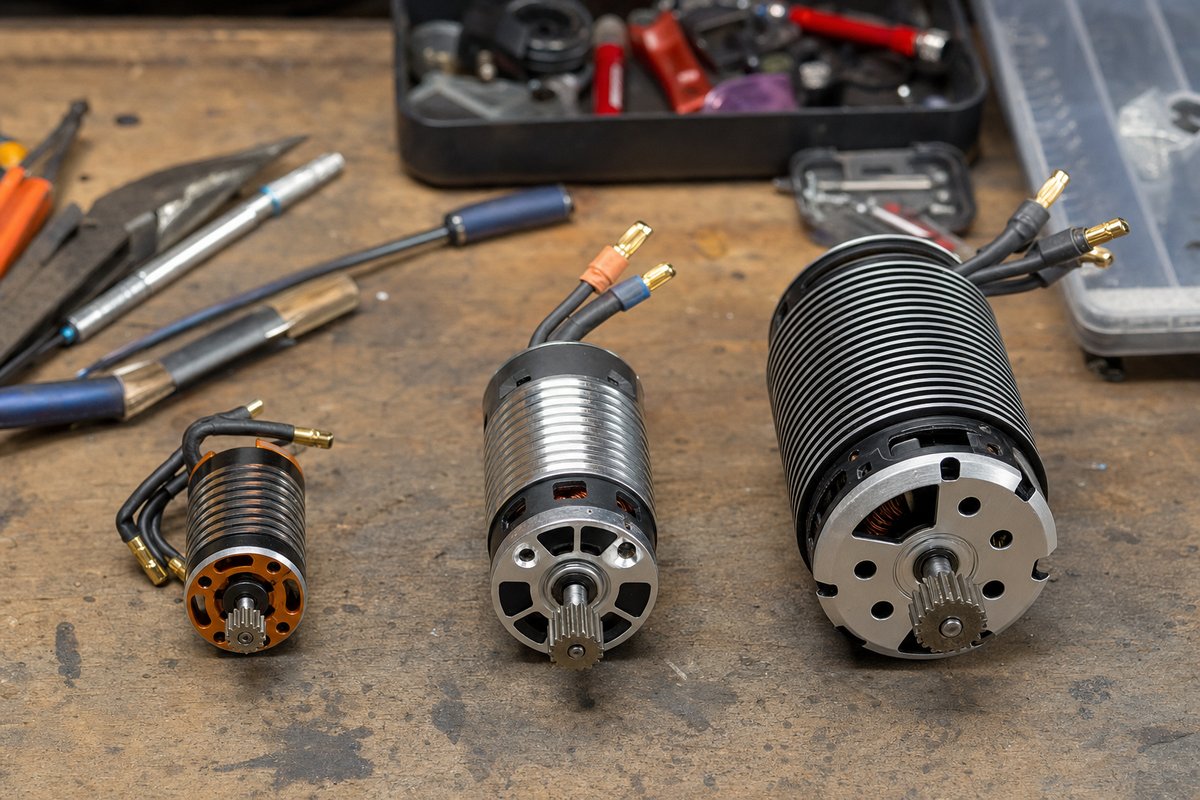
A 550 can is physically larger in diameter and length than a 540, which gives it more internal room for copper windings and magnets and, at a comparable KV, generally more torque headroom and better heat dissipation under sustained load. A 600 or 700 size can steps up again, into the range mostly seen on 1/8 scale buggies and truggies, where the vehicle's weight and tire size demand more sustained torque than a 540 or 550 can comfortably deliver. None of that means a 550 automatically outperforms a 540 in every situation, since a high-KV 540 can easily outpull a low-KV 550 of the same nominal size; the can-size number sets the physical envelope, not the output.
Brushless motors adopted a related but different labeling convention. Instead of a single three-digit can code, most brushless motors sold for RC cars and trucks carry a four-digit code, something like 3650 or 4274, where the first two digits are the stator's diameter in millimeters and the last two are its length. Reading a rc brushless motor size chart correctly starts with understanding that this four-digit code does the same physical-envelope job the older 540/550 convention did for brushed motors, just with more precision about the exact stator dimensions rather than a rounded category name.
Because the brushless convention encodes actual millimeter dimensions, two motors with close but not identical codes, a 3650 and a 3660 for instance, are not interchangeable even though both would loosely get called "36-size" motors in casual conversation. The extra 10mm of stator length in a 3660 adds meaningful torque and thermal capacity over a 3650, which matters when sizing a motor against a heavier vehicle or a more demanding use case.
How KV Rating Interacts With Can Size
KV describes how many RPM a motor spins per volt applied with no load, and it is the number that actually determines how a given can size will feel once it is installed, more than the can code alone ever will. A 3300KV motor spins roughly 3300 times faster per volt than a 1000KV motor of the same physical size, because the difference comes down to winding: fewer turns of thicker wire produce a higher-KV, higher-RPM, lower-torque motor, while more turns of thinner wire produce a lower-KV, higher-torque, lower-RPM motor from the identical can.
That winding relationship is why the same 540 can size ships across an enormous KV range, from under 2000KV crawling motors up past 8000KV in some stock-class racing motors. The can sets the outer limit on how much copper and magnet a manufacturer has to work with; the winding decision inside that limit is what actually determines whether a given 540 favors torque or top speed.
This is the piece a rc brushless motor size chart needs to show alongside can size, not instead of it. A chart that lists only stator codes without a companion KV column tells a buyer the physical envelope a motor will fit but says nothing about whether that specific motor favors torque or RPM, which is the decision that actually matters once the can size question is settled.
Comparing across can sizes rather than within one adds a second variable. A larger can at a lower KV and a smaller can at a proportionally higher KV can land near the same RPM output, but the larger can generally holds up better under sustained load because it has more thermal mass and winding area to dissipate heat, which is why bigger vehicles lean toward bigger cans at moderate KV rather than small cans pushed to very high KV to compensate.
RC Motor Sizes by Vehicle Scale and Use Case
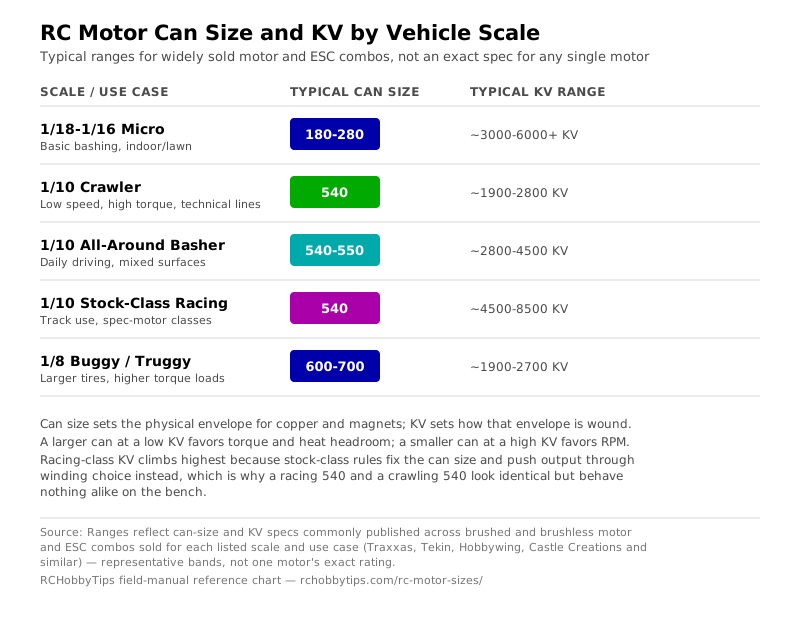
Sorting rc motor sizes by vehicle type is the fastest way to avoid an expensive mismatch, since the right can size and KV band depends far more on the vehicle's scale, weight and intended use than on any single spec-sheet number. The rc motor size chart below groups typical can-size and KV ranges by scale and use case, pulled from widely sold motor and ESC combos for each category rather than any single manufacturer's exact rating.
| Scale / Use Case | Typical Can Size | Typical KV Range | Notes |
|---|---|---|---|
| 1/18-1/16 Micro Scale | 180-280 | ~3000-6000+ KV | Small chassis, low mass, tolerates high KV without overheating |
| 1/10 Crawler | 540 | ~1900-2800 KV | Low-end torque prioritized over top speed for technical lines |
| 1/10 All-Around Basher | 540-550 | ~2800-4500 KV | Balanced range most stock-replacement combos ship in |
| 1/10 Stock-Class Racing | 540 | ~4500-8500 KV | Can size fixed by class rules; output set by winding instead |
| 1/8 Buggy / Truggy | 600-700 | ~1900-2700 KV | Larger tires and vehicle weight need more sustained torque |
Embed this chart
The chart above and the reference figure both group rc motor sizes by vehicle type rather than by can code alone, since the same 540 can shows up in a crawler, a basher and a stock-class racer with three very different KV ratings and three very different personalities on the trail or track.
Two patterns are worth calling out. First, can size does not climb in a straight line with vehicle scale: a 1/10 stock racer and a 1/10 crawler both commonly run a 540 can despite having almost nothing else in common in how they get driven, because the racing class rules typically fix the can size and let KV and winding do the differentiating instead. Second, KV runs highest at the small-scale end and the racing end for very different reasons. Small chassis run high KV because there is little mass to overheat a small can, while stock racing runs high KV because the rules cap can size and push output through winding choice instead.
Brushed vs Brushless Motor Sizing Differences
Brushed and brushless motors size up differently even when the can looks similar from the outside. A brushed motor's KV is fixed the moment it leaves the factory, set entirely by the winding turns count baked into that specific motor, so buying a different KV brushed motor means buying an entirely different physical motor. Brushless motors work the same way in practice, each specific KV is still its own wound unit, but the four-digit stator code makes it easier to compare motors across brands at a glance, since the dimensions are explicit rather than rounded into a category name.
Construction differs too. Most brushed RC motors are built as what is called an inrunner, with the magnets fixed to the outer can and the wound armature spinning inside on the shaft. Most brushless RC car and truck motors flip that arrangement and run as an outrunner instead, with the magnet housing spinning around a fixed internal stator; the outrunner layout favors torque at a given size, which is part of why brushless motors deliver more usable torque than a similarly sized brushed motor. The full construction comparison, including why a few specialty applications still use brushless inrunners, is covered in the inrunner vs outrunner explainer.
Heat handling is the other real difference. A brushed motor loses energy to physical friction between the brushes and commutator, and that friction both wastes power and limits how much continuous current the motor tolerates before the brushes wear out or the commutator scorches. A brushless motor of a comparable can size runs cooler at the same output because there is no brush contact generating that friction loss, which is a meaningful part of why brushless conversions on the same can size regularly outperform the brushed motor they replaced, beyond just the power curve difference.
Mounting is usually the compatible part. A brushless motor built to a given can-size mounting pattern, most commonly a 540-pattern replacement, bolts to the same motor plate and meshes with the same pinion and spur setup as the brushed motor it is replacing, which is why a brushed-to-brushless swap on the same nominal can size rarely requires a new motor mount. Shaft diameter is worth double-checking anyway, since it can differ slightly between a stock brushed motor and an aftermarket brushless replacement even at the same can code, and a pinion bored for the wrong shaft diameter will not seat correctly no matter how well everything else matches.
Common Motor Size and KV Mismatches to Avoid
The most common motor-sizing mistake is picking a can size or KV based on what a vehicle could theoretically fit rather than what it can actually cool and drive reliably. A high-KV motor dropped into a heavy 1/8 buggy chassis built around a 600 or 700 size can at moderate KV will spin fast on the bench and then overheat or trip ESC thermal cutback the first time it is driven under real load, because the vehicle's weight and tire size demand sustained torque the high-KV setup was never wound to provide.
Undersizing works the other direction. A crawler-spec low-KV 540 dropped into a stock-class racing chassis will feel sluggish and uncompetitive no matter how well everything else on the vehicle is tuned, since the winding was chosen for torque and heat margin at low RPM, not for the high-RPM output a racing class expects from the same can code.
Chassis-specific mounting is a mismatch that catches even experienced hobbyists off guard, since two chassis platforms that look similar on paper can differ meaningfully in motor plate hole spacing, gearbox layout or shaft clearance. The Tamiya TT-01 vs TT-02 comparison is a good example of how much a gearbox redesign between two closely related chassis generations can change which motors and pinions actually fit, even when both platforms nominally accept the same 540-size can.
Assuming a same-numbered can from a different manufacturer is a drop-in match is another recurring mistake. Two motors both labeled 540, or both labeled 3650, can differ by a millimeter or two in actual length or shaft height between brands, which is usually harmless on an open chassis but can bind against a tight endbell clearance on a fully enclosed one. Checking a new motor's physical dimensions against the old one before assuming a swap, rather than trusting the size label alone, avoids a return trip to the workbench.
Ignoring cell count is the last common mismatch. Running 3S instead of 2S multiplies a motor's effective RPM by roughly 1.5x at the same KV, so a motor and ESC combo sized correctly for 2S can run into the same overheating and thermal-cutback problems as an oversized KV pick if the pack gets upgraded without also rechecking the motor and ESC's rated cell count.
Gearing Considerations When Changing Motor Size or KV
Gearing and motor sizing are not separate decisions; changing either one without rechecking the other is one of the fastest ways to turn a reasonable motor choice into an overheating problem. Moving to a higher-KV motor at the same can size, without also stepping down the pinion or up on the spur, pushes RPM and heat past what the motor and ESC were designed to sustain, even when the KV number by itself looks reasonable for the vehicle's scale and use case.
Moving to a different can size at a similar KV changes the equation differently. A larger can generally has a taller shaft height and can carry a physically larger pinion without the pinion-to-motor-shaft ratio feeling undersized, but the exact fit still depends on the specific motor and chassis, so mesh should always get rechecked rather than assumed to carry over from the previous motor's pinion setting.
Torque-heavy custom builds make gearing considerations especially visible. A build like the one covered in the RC pulling tractor guide deliberately gears down hard and runs a torque-favoring, lower-KV motor rather than reaching for the highest-KV option the chassis could physically accept, since a pulling application rewards sustained low-RPM torque over top speed in a way that overrides the usual bashing or racing sizing logic.
As a working check after any motor size or KV change: confirm the pinion and spur mesh with a strip of paper, run the vehicle for a few minutes under normal load, and feel the motor can and ESC heatsink immediately afterward. A can that is uncomfortably hot to hold, well before the ESC trips thermal cutback, is usually a sign the gearing needs to come down a step even if the motor and ESC themselves are correctly matched to the vehicle.
Putting the RC Motor Size Chart to Use: A Quick Buying Guide
Used alongside the vehicle's stock gearing and ESC rating, this rc motor size chart turns a guess about can size and KV into a straightforward decision keyed to how the vehicle actually gets driven: start from the scale and use-case row that matches the vehicle, treat the can-size and KV ranges as a starting point rather than a hard rule, and confirm mesh and heat after any change rather than assuming a spec-sheet match is a real-world match.
Electric motor sizing is only half the reference picture for hobbyists running a mixed fleet. Nitro engines use a completely different displacement-based sizing convention with their own fuel and break-in considerations, covered separately in the nitro RC fuel guide for anyone cross-shopping an electric and a nitro platform side by side.
Browse the rest of the Gear & Reference section for chassis comparisons, wiring guides and other reference material that pairs with a motor sizing decision, since a can-size or KV change on a vehicle rarely stays an isolated decision once gearing, ESC and battery all get rechecked to match.
Frequently Asked Questions
What does the number in an RC motor size, like 540 or 550, actually mean?
It is a can dimension from a shared industry sizing convention, not a power rating. A 550 can is physically larger than a 540, with more room for copper and magnets, which usually means more torque headroom at a comparable KV, but the number alone does not say how hard a specific motor actually pulls.
What is KV rating and how does it relate to motor size?
KV is a motor's unloaded RPM per volt, set by the winding turns inside a given can rather than by the can size itself. The same 540 can ships across a huge KV range because manufacturers wind different turn counts into that identical physical envelope.
How do I read a rc brushless motor size chart?
Look for two numbers together: the four-digit stator code, such as 3650, that sets the physical envelope, and a separate KV rating that sets whether that specific motor favors torque or RPM. A rc brushless motor size chart listing only one of the two is missing the half that actually determines how the motor performs.
What size motor should a 1/10 scale crawler run?
Most 1/10 crawlers run a 540-size can, brushed or brushless, wound to a low KV in roughly the 1900-2800 range, which favors low-end torque and heat margin over top speed for slow, technical driving.
What size motor should a 1/8 scale buggy or truggy run?
1/8 buggies and truggies typically run a larger 600-700 size can at a moderate KV, usually in the 1900-2700 range, since the vehicle's weight and larger tires demand more sustained torque than a 540 or 550 can comfortably deliver.
Can a larger can-size motor replace a smaller one in the same chassis?
Sometimes, but only after checking the motor plate hole spacing, shaft height and endbell clearance against the chassis, since a larger can that does not physically clear the gearbox housing or chassis rails will not seat correctly even if the pinion and spur otherwise mesh fine.
Does a higher KV motor always mean more speed?
Not on its own. A higher-KV motor spins faster per volt, but actual top speed also depends on gearing, cell count and how well the ESC can sustain the resulting current draw, so a high-KV motor geared or powered incorrectly can end up slower and hotter than a lower-KV motor set up correctly.
What's the most common mistake matching motor size to a vehicle?
Picking a can size or KV based on what could theoretically fit rather than what the vehicle can actually cool and drive reliably under real load, which usually shows up as ESC thermal cutback or an overheating can the first time the vehicle gets driven hard instead of just bench tested.
How does gearing change when moving to a different motor size or KV?
A higher-KV motor generally needs a smaller pinion or larger spur to keep RPM and heat inside the motor and ESC's rated range, while a larger can size at a similar KV usually tolerates a larger pinion, though mesh should always get rechecked rather than assumed to carry over.
Are brushed and brushless motors sized the same way?
Similarly but not identically. Brushed motors use the older three-digit can codes like 540 and 550, while most brushless motors sold for RC cars use a four-digit stator code like 3650 that spells out diameter and length in millimeters directly, alongside a separate published KV rating either way.
Can I trust rc motor sizes by vehicle type as a hard rule?
Treat rc motor sizes by vehicle type as a starting point, not a hard rule. A pulling-tractor build or a purpose-built crawler can deliberately gear and wind outside the typical range for its scale, so the chart is most useful for narrowing the search, with mesh and heat checks confirming the final pick.
What size motor fits a 1/18 to 1/16 scale micro RC vehicle?
Micro-scale vehicles typically run a small 180-280 size can at a high KV, often in the 3000-6000+ range, since the low chassis weight tolerates the extra heat a high-KV motor generates far better than a larger, heavier vehicle would.
Can a brushless motor with a four-digit stator code replace a brushed 540 motor directly?
Usually yes for mounting, since most brushless motors built to a 540-pattern bolt to the same motor plate and mesh with the same pinion and spur setup. Shaft diameter can still differ slightly between the stock brushed motor and the brushless replacement, so it is worth checking before assuming the pinion carries over unchanged.
How can I identify a motor's size if the printed label is worn off?
Measure the can's diameter and length directly with calipers and compare the figures against known can-size or stator-code dimensions, since the numbers in both sizing conventions describe physical measurements rather than an arbitrary name. A worn label does not change the motor's actual envelope, only the ability to read it at a glance.
Does a larger can size or a higher KV do more for extra torque?
A larger can size at a similar KV generally adds more usable torque and heat headroom, since it has more room for copper and magnets to begin with. Raising KV inside the same can trades torque for RPM through the winding change, so it does not add torque the way stepping up in can size does.
Is a stock-class racing motor sized differently than a modified-class motor?
Stock classes typically fix the can size, commonly 540, and restrict the winding or KV range so competitors race on comparable hardware, while modified classes usually open up can size and KV choice entirely, letting racers run a larger can or a higher-KV winding than stock rules would allow.
What's the risk of fitting a larger motor than a chassis was designed for even if it physically clears everything?
A larger motor usually draws more current and adds rotating mass, so the ESC, battery and gearing all need rechecking against the new draw even when the can bolts up cleanly. Fitting a bigger motor without revisiting those three is a common way to trip ESC thermal cutback or drain a pack faster than expected.