XT60 vs XT90 — Connector Comparison and Amperage Guide
Melt an XT30 connector on a 6S pack pulling real current and the nylon housing warps before the wire even gets hot. That's usually the first real lesson in XT60 vs XT90 connector amperage: the bullet connector on a build isn't a detail to eyeball, it's the actual ceiling on how much current a battery can safely deliver to whatever's drawing power on the other end. XT60 and XT90 look almost identical at a glance, same yellow-or-orange nylon housing, same two-bullet-pin layout, and the difference between them comes down entirely to how much continuous amperage each size is built to carry.
Get that ceiling wrong and the failure mode ranges from an underpowered ESC browning out mid-run to a genuinely melted connector.
This guide walks through what separates the two sizes, where XT30 and XT150 fit around them, when a build actually needs to move up from XT60 to XT90, and the soldering details that matter more than most builders expect. Amass, the manufacturer behind the XT-series naming most of the hobby uses, publishes the continuous-current figures this whole comparison is built on. If a pack is already in hand and only a straight number is needed, the calculator further down in the "Full Amperage Ladder" section does the math directly.
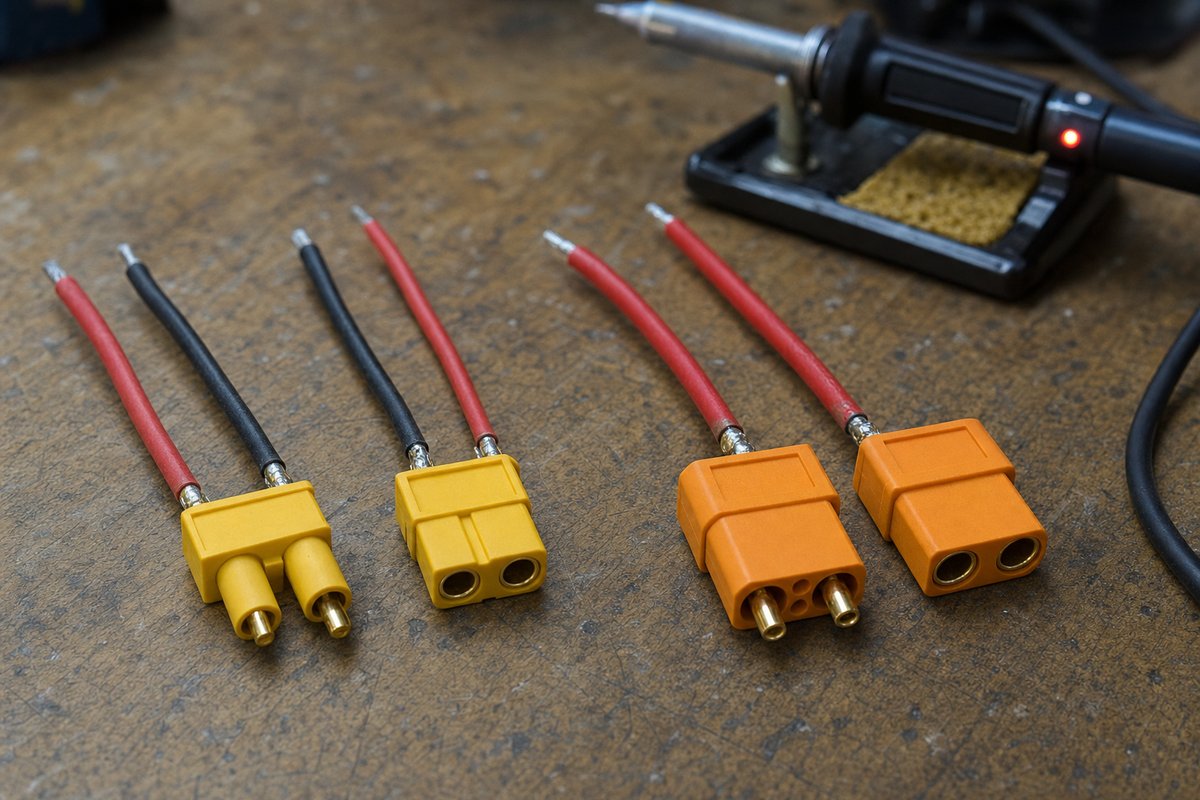
XT60 vs XT90: What These Connectors Are For
Both XT60 and XT90 are two-pin bullet connectors: a male half with two exposed bullet pins and a female half with matching sockets, keyed so they only mate one way. XT60 is the connector most 3S-4S LiPo packs ship with out of the box, and it's the default on everything from a Traxxas Slash 4x4 to a mid-size FPV quad. XT90 is the step up, built with a larger housing and thicker pins to carry more continuous current without the pins arcing or the housing overheating under sustained load.
Traxxas actually ships some of its own vehicles with a proprietary connector instead of XT60, a holdover from before XT-series bullets became the de facto hobby standard, and untangling that particular quirk is a separate rabbit hole from the amperage question this guide is answering. What matters here is the connector on the battery and the connector on the ESC or charger it plugs into, and whether those two ratings actually match the current the build draws.
Continuous Amperage Ratings: The XT60 vs XT90 Comparison
The numbers behind the XT60 vs XT90 comparison are straightforward once they're laid out together: XT30 is rated around 30A continuous, XT60 around 60A, XT90 around 90A, and XT150 around 150A, per the figures Amass publishes and that most RC and FPV retailers repeat on their product pages. That's the entire XT60 vs XT90 connector amperage story in one sentence: XT90 buys roughly 50% more continuous headroom than XT60, from a bigger housing and thicker bullet pins, and nothing else changes between them.
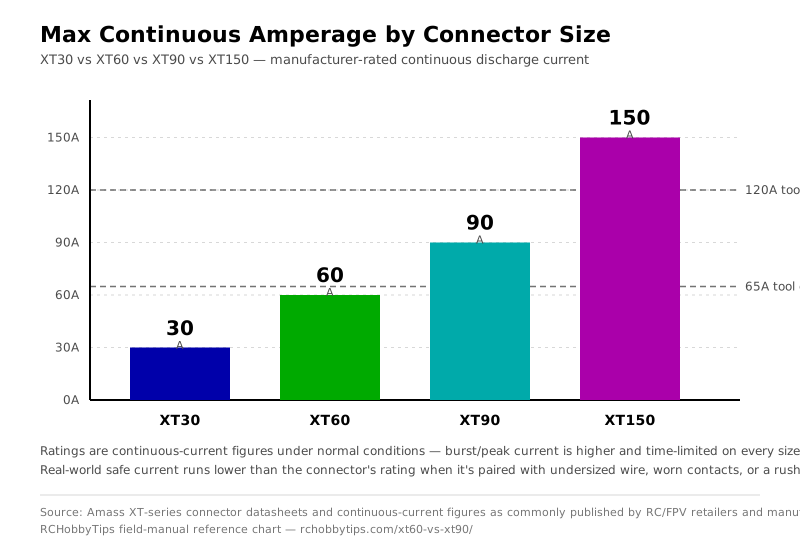
Embed this chart
XT30 vs XT60 vs XT90 vs XT150: The Full Amperage Ladder
Seen as a full ladder rather than a single XT60 vs XT90 face-off, the pattern is simple: each step up roughly doubles or 1.5x's the continuous-amp ceiling of the last. XT30 covers small whoops and 1S-2S micro builds under about 20A of real draw. XT60 covers the broad middle of the hobby, most 3S-4S cars, planes and mid-power quads pulling up to roughly 60-65A. XT90 takes over from there through about 90-120A, which covers high-C-rating 4S packs and most 6S setups. Past that, builds either move to XT150 or start running connectors in parallel to split the load across more than one pair of pins.
Those 65A and 120A cutoffs aren't arbitrary. They're the same practical rounding many builders use to leave a safety margin below a connector's rated maximum rather than running right up against it, and it's the logic behind the calculator below.
None of this requires memorizing a ladder, though. The tool below takes a pack's actual cell count, capacity and C-rating and turns it directly into a continuous-amp figure and a suggested connector size, using the same 65A and 120A cutoffs referenced above.
Calculated from nominal cell voltage (3.7V/cell) and continuous C-rating. Actual safe limits vary by battery brand and connector manufacturer spec — treat this as a starting estimate, not a substitute for the manufacturer's datasheet.
Type in a 4S 5000mAh 50C pack, the defaults loaded above, and the calculator returns roughly 250A on paper. That's well past what a single XT60 or even XT90 is rated to carry continuously, which is exactly why packs pulling that kind of theoretical C-rating usually rely on heavier wire, real-world draw far below the label's ceiling, or occasionally parallel connectors rather than betting everything on one bullet pair.
Physical Size and XT60 XT90 Compatibility
The short version of XT60 XT90 compatibility is that they don't share a housing size, so a female XT60 will never accept a male XT90 pin, and there's no forcing it without damaging both. XT90's housing is visibly larger and its bullet pins run thicker in diameter, roughly 4mm on XT60 versus roughly 4.5-5mm on XT90 depending on the manufacturer's tolerance, which is also what gives it the higher current rating in the first place: more contact surface between the pins means less resistance and less heat at a given amp draw. Side by side on a bench the size gap is obvious even without a caliper; the confusion mostly happens when a builder is going off a spec sheet or an online listing photo instead of the part in hand.
Adapter leads sidestep the XT60 XT90 compatibility question by soldering an XT60 pigtail onto an XT90-terminated pack, or the reverse, rather than trying to mate the housings directly. That's a reasonable stopgap for testing a pack against an ESC with the "wrong" connector, but it isn't a substitute for re-terminating the pack properly if the mismatch is going to be permanent.
XT60 and XT90 on the Charging Side
The main power connector and the balance lead are two separate questions, and it's easy to conflate them. The balance connector, the small multi-pin JST-XH-style plug most packs also carry, has nothing to do with XT60 or XT90 and stays the same regardless of which main connector a pack uses. XT60 and XT90 only handle the pack's actual charge and discharge current through the main leads.
Parallel charging boards, the small PCBs hobbyists use to charge several packs at once off a single charger output, almost always standardize on XT60 or XT60-derivative sockets rather than XT90, since most parallel-charged packs are lower-capacity 3S-4S packs charging at a fraction of their discharge C-rating. A pack that discharges through an XT90 for flight or driving can still charge through an XT60 parallel board without any conflict, because charge current is typically a small fraction of the discharge rating either connector is built for.
When to Upgrade from XT60 to XT90
The upgrade decision comes down to actual sustained current, not cell count or capacity alone. A 4S pack feeding a moderately loaded brushless system rarely needs more than XT60 provides. The clearer upgrade candidates are 6S packs with high C-ratings, brushless boat setups running at or near full throttle for extended stretches, and FPV builds drawing hard, continuous current through an entire flight rather than short bursts; see sizing a brushless motor for an RC boat and powering an FPV camera correctly for two load profiles where that sustained draw actually shows up.
If a build already runs warm-but-fine on XT60 after a hard session, that's usually not a signal to upgrade. If the housing shows any deformation, discoloration, or a pin that's started to feel loose in its socket, that's the actual trigger, and it applies regardless of which size is currently installed.
Soldering and Crimping XT60 vs XT90 Connectors
Both sizes solder the same way in principle: strip the wire, tin the pin's solder cup, flow solder into the cup and press the wire in while it's still liquid, then let it cool undisturbed before adding heat-shrink over the joint. XT90's larger pins take more heat to bring up to soldering temperature, so a 60W-plus iron does the job noticeably faster and more reliably than the 25-30W iron that's fine for XT30 work. A cold joint, one where the solder looks dull and grainy instead of smooth and shiny, is a common failure point on both sizes and is worth reflowing rather than trusting.
Crimping is the alternative some builders prefer for XT90 specifically, since the thicker pins can be harder to heat evenly with a small iron; a proper crimp tool rated for the pin gauge gives a more consistent joint than an underpowered soldering setup fighting the pin's thermal mass. Either way, the connector's rated amperage assumes a correctly finished joint. A rushed one quietly turns a 90A-rated connector into whatever the weakest solder blob can actually carry.
Common Wiring Mistakes That Waste a Connector's Rating
The single most common mistake is pairing a properly rated connector with wire that's too thin for the current it's meant to carry: a 12-14AWG XT60 setup and a 10-12AWG XT90 setup are the usual pairings, and going a size or two thinner on the wire undermines the connector's rating no matter how good the solder joint is. Skipping heat-shrink over a freshly soldered joint is the second most common issue, since exposed solder cups are prone to shorting against a chassis or another wire in a tight build.
Mismatched genders between a pack and its charger or ESC is a smaller but real annoyance rather than a safety issue, and it's the reason some builders standardize their whole fleet on one connector size even when a smaller build, something pulling 20A on a 2S whoop-class setup, would technically be fine on XT30. In that case the XT30 vs XT60 decision is really a wire-gauge and weight question, not an amperage one.
Cost and Availability
XT60 pairs run around $0.50-1 apiece in bulk from most hobby retailers and come pre-installed on the overwhelming majority of 3S-4S packs sold today. XT90 costs a little more per pair and ships standard on most 6S packs and higher-C-rating 4S packs above roughly 5000mAh. XT150 sits well above both in price and shows up almost exclusively on large-scale gas-to-electric conversions and bigger RC boats pulling triple-digit continuous amperage, where it's less a premium option than the only connector rated for what the build actually draws. A 6S 6000mAh 100C pack shipping with an XT90 out of the box stopped being a premium feature years ago; on that class of pack, it's just the connector that matches the current, the same logic that decides whether the pack itself is worth a graphene upgrade in the first place, and the same reasoning behind reading a pack's C-rating label with some skepticism before trusting either number blind.
Can I use an XT60 connector on a 6S battery?
Physically yes, since XT60 doesn't care about voltage, but it's a bad idea once a 6S pack is paired with a high C-rating and a power-hungry motor. The limiting factor is continuous amperage, not cell count, and a 6S pack pulling well past 60A on a sustained basis will run an XT60 connector hotter than it's rated for.
What's the actual amperage difference between XT60 and XT90?
XT60 is rated around 60A continuous, XT90 around 90A continuous, per the ratings commonly published by Amass and the retailers that sell XT-series connectors. That's roughly 50% more continuous headroom on the XT90 side, from a larger housing and thicker bullet pins.
Are XT60 and XT90 connectors interchangeable?
No. The housings are different sizes and the bullet pins are different diameters, so a female XT60 will not accept a male XT90 pin or vice versa. Moving between the two means re-terminating the wire with the correct connector or using a soldered adapter lead.
Can I solder an XT90 connector onto a pack that came with XT60?
Yes, as long as the wire gauge already running to the pack can handle the higher current an XT90 implies. Swapping the connector alone doesn't raise the pack's actual discharge capability, so check the C-rating and wire gauge before assuming the upgrade did anything.
What size wire should I use with XT60 vs XT90 connectors?
Most XT60 builds run comfortably on 12-14AWG silicone wire, while higher-current XT90 setups typically move to 10-12AWG to avoid the wire itself becoming the bottleneck. A connector's rating is only as good as the wire soldered to it.
Is XT90 heavier than XT60?
A little, but not enough to matter on most builds. The larger housing and thicker pins add a few grams per connector, which is negligible next to the weight of the battery pack and wire it's attached to.
Do XT60 and XT90 connectors come in different colors for a reason?
The yellow-vs-orange convention Amass uses is mostly a quick visual sort at the workbench rather than a spec requirement, and some manufacturers deviate from it. Size and pin diameter are what actually determine compatibility, not housing color.
What connector should a 4S 5000mAh 50C pack use?
That pack works out to roughly 250A on paper (5Ah x 50C), which is well past what a single XT60 or even XT90 is rated to carry continuously. In practice most 4S packs in that range still ship on XT60 because real sustained draw rarely approaches the theoretical C-rating ceiling, but it's worth checking the actual motor and ESC draw before assuming that's safe.
Can XT30 handle a 3S pack?
It depends on current, not cell count. A 3S pack in a lightweight whoop or small FPV build pulling under 30A continuous is a normal XT30 application; the same 3S pack feeding a 1/10-scale crawler's motor under load can exceed that easily and calls for XT60 instead.
How do I know if my connector is melting or just warm?
Warm-to-the-touch after a hard run is normal. Deformed, soft, or discolored nylon housing, a loose pin that wiggles in its socket, or a scorched smell means the connector has exceeded its rating and should be replaced, not reused.
Is XT150 overkill for most RC builds?
For the vast majority of cars, planes and small-to-midsize boats, yes. XT150 shows up mainly on large-scale gas-to-electric conversions, bigger RC boats, and high-power robotics projects pulling continuous current well past what any car or plane motor draws.
Do ESCs come with XT60 or XT90 pre-installed?
It varies by ESC amperage rating rather than a fixed rule. Lower-current ESCs commonly ship with XT60 pigtails, while ESCs built for high-current brushless setups more often arrive with XT90 or bare wire leads left for the builder to terminate.
Can XT60 and XT90 connectors be mixed on the same battery pack?
It's unusual but sometimes seen on packs with a separate main-power lead and a lower-current secondary or accessory lead, where the accessory circuit doesn't need the main connector's rating. Mixing sizes across two different leads serving two different loads is fine; using two different connectors on what should be a single matched main-power path is not something manufacturers do.
Do XT60 and XT90 connectors have a polarized housing that prevents reverse insertion?
Yes, both use a keyed housing shape that only allows the male and female halves to mate one way, preventing a pack from being plugged in backward and reversing polarity into an ESC or charger. That keying is a housing-design feature rather than something a builder checks manually, though it's worth confirming a connector isn't cracked or deformed in a way that defeats it.
Does connector resistance actually cause a measurable voltage drop under load?
Yes, and it becomes more noticeable as current climbs. Every connector adds some contact resistance at the pin interface, and at high continuous amperage that resistance translates into a real voltage drop between the battery and the ESC, plus the heat that drop generates at the connector itself. An undersized connector for the actual current draw loses more voltage to this effect than a properly sized one.