C2 vs C4 Battery Ratings Explained — A Full Guide
A c2 vs c4 battery comparison trips up a lot of buyers because the two labels look like they belong to the same family of numbers as the familiar single C-rating printed on most hobby LiPo packs, and they don't quite work the same way. This guide walks through what C-rating notation actually measures, how the two-tier C2/C4 style differs structurally from a single-number rating like 30C or 50C, how to turn either scheme into a real max-amp figure with simple math, how to match a rated capacity to what an ESC and motor actually draw, the mistakes buyers make most often when comparing the two schemes, and what safety margin to build in once the numbers are in hand.
What C-Rating Notation Actually Means
A C-rating is a multiplier applied to a battery's rated capacity to estimate its maximum discharge current. The math is the same regardless of which labeling style ends up printed on the wrapper: convert the pack's capacity from milliamp-hours to amp-hours, then multiply by the C-number. A 5000mAh pack is 5Ah, so a 30C rating works out to 5 x 30, or 150A of theoretical continuous discharge current. That number describes what the cells are rated to sustain, not necessarily what the wire gauge, connector, or the rest of the electrical system can safely carry, which is a separate check covered later in this guide.
Most premium and mid-range LiPo packs sold for RC cars, planes, and boats use exactly one C-number on the label, commonly somewhere between 25C and 100C depending on the cell chemistry and how aggressively the manufacturer rates it. That single figure is meant to represent a continuous discharge rating, though in practice it's often closer to an optimistic ceiling than a number a pack can sustain indefinitely without heating up. Nothing about the single-number format inherently distinguishes a sustained rating from a short burst rating; the one printed number is doing both jobs at once, which is part of why the two-tier alternative exists.
The C2 vs C4 Battery Difference, Explained
The c2 vs c4 battery distinction shows up mainly on budget and toy-grade RC packs, where the manufacturer prints two separate multipliers instead of one: a lower number, commonly written as C2, for continuous discharge, and a higher number, commonly written as C4, for short burst draw such as hard acceleration off the line. Structurally that's a different labeling scheme from a single C-number rating, not just a different way of writing the same figure. A single-number pack gives one multiplier and expects the buyer to treat it as roughly continuous. A two-tier C2/C4 pack gives two multipliers up front and separates the sustained figure from the burst figure explicitly, which is a more conservative and arguably more honest way to represent real discharge behavior, especially on cells that genuinely can't sustain a high multiplier for more than a few seconds.
It's worth being direct about the limits of this explanation: there is no single industry-wide standard that locks C2 and C4 to exactly "2C continuous" and "4C burst" across every manufacturer the way there's rough, if imperfect, consensus around what a single C-number is supposed to represent. The 2x and 4x multiplier interpretation is the most common one reported across RC battery datasheets that use this two-tier format, and it's the interpretation used throughout this guide's math, but a specific pack from a specific brand can define its own C2 and C4 figures slightly differently. Checking the actual datasheet or packaging for the pack in hand, rather than assuming every C2/C4 label means precisely 2x and 4x, is the safer habit. Understanding the c2 vs c4 rc battery difference in structural terms, two separate multipliers versus one combined multiplier, matters more than memorizing an exact universal formula, because that structural difference is what's consistent even when the precise numbers vary.
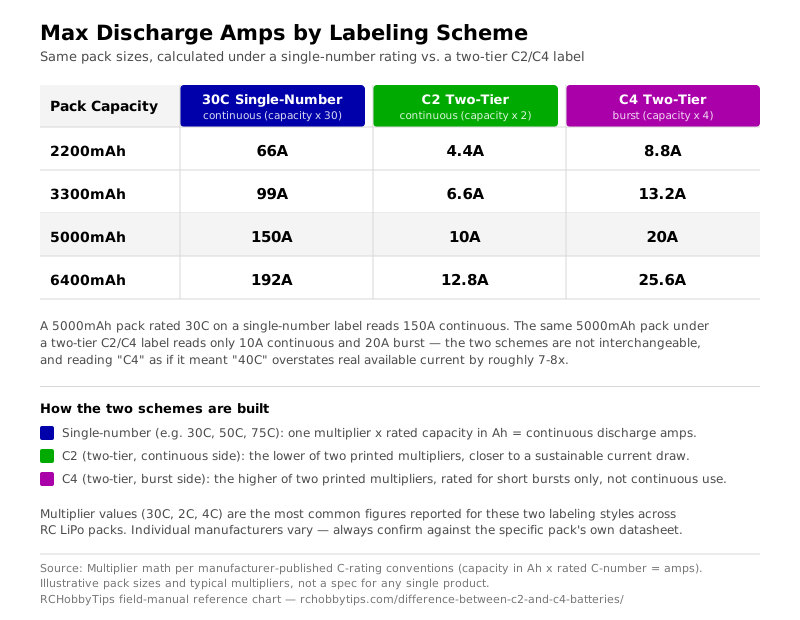
The chart below applies the 2x/4x interpretation to a handful of common pack sizes and lines the results up against a typical 30C single-number rating at the same capacities, which makes the practical gap between the two schemes easy to see at a glance.
Embed this chart
Calculating Real Max Discharge Amps From Either Scheme
The arithmetic behind a c2 vs c4 battery figure is the same simple formula used for any C-rating: capacity in amp-hours multiplied by the printed multiplier equals amps. For a two-tier pack, run the formula twice, once for each printed number, to get a continuous figure and a burst figure. A 3300mAh pack rated C2/C4 is 3.3Ah, so the continuous side is 3.3 x 2 for 6.6A, and the burst side is 3.3 x 4 for 13.2A. For a single-number pack, the same 3300mAh capacity at 30C comes out to 3.3 x 30, or 99A, all under one figure with no separate burst number called out.
Quick formula: capacity (mAh) ÷ 1000 = capacity (Ah). Capacity (Ah) × C-number = amps. Do this once per printed multiplier — twice for a two-tier C2/C4 pack, once for a single-number pack.
This c2 c4 battery rating explained method turns two unfamiliar printed numbers into a comparable amp figure in under a minute, and it's the only reliable way to compare a two-tier pack against a single-number pack of a different capacity. Comparing raw C-numbers directly, a "C4" pack against a "40C" pack, for example, compares two numbers that were never meant to describe the same kind of rating and will produce a wildly misleading impression of which pack actually delivers more current.
Matching a Rated Capacity to ESC and Motor Draw
Once a pack's real amp figures are known, matching it to a motor and ESC combination is a straightforward headroom check. The motor and ESC's expected continuous current draw, not their absolute maximum rating, is the number to check against the battery's continuous-discharge figure — the C2 side on a two-tier pack, or the single printed C-number on a standard pack. Pull the ESC's own continuous amp rating into the comparison too, since a battery capable of supplying more current than the ESC can handle doesn't help; the ESC's rated amperage against motor draw and against battery discharge capability all need to line up together, not just any two of the three.
Connector choice belongs in this same check. A pack rated for genuinely high continuous current through an undersized connector is a bottleneck the C-rating math never accounts for; the XT60 vs XT90 connector comparison covers when a stock connector has enough headroom for a higher-discharge pack and when stepping up the connector is worth doing. Smaller packs paired with lighter-duty electronics see the same logic at a lower current range, which the XT30 vs XT60 connector breakdown covers for 1S-2S builds that never approach the current levels a 4S or 6S setup reaches.
Cell chemistry variants add one more variable worth checking before assuming a printed C-number tells the whole story. Some newer packs marketed with additive-based chemistry claim sustained discharge behavior that differs from a standard LiPo cell at the same printed rating; the graphene battery vs. LiPo comparison covers what that additive actually changes and when the price premium over a standard pack is worth paying for a build that genuinely needs the extra sustained headroom.
Common Buyer Mistakes With C2/C4 and Single-Number Packs
The single most common mistake in any c2 vs c4 battery decision is reading "C4" as though it were shorthand for a high single-number rating like 40C. It isn't. A C4 figure on a two-tier pack is a burst multiplier layered on top of a separate, much lower continuous figure, while a 40C single-number rating is meant to apply across the board. Treating the two as equivalent overstates the two-tier pack's real continuous capability by roughly seven to eight times at typical multiplier values, which is exactly the kind of gap that leaves a higher-power motor starved for current mid-run.
Sizing an ESC or motor against a two-tier pack's C4 burst figure instead of its C2 continuous figure is the second common mistake, and it compounds the first one. An ESC and motor combination that draws anywhere near the burst number continuously will push the pack well past what its cells can sustain, leading to voltage sag, excess heat, and accelerated capacity loss over the pack's life. The C2 continuous figure, not the more attention-grabbing C4 number, is the one that belongs in a sizing calculation for anything beyond a brief acceleration spike.
A third mistake runs the other direction: assuming every high-discharge use case needs a single-number pack rated in the 50C-100C range when a correctly sized two-tier pack, run within its C2 continuous figure, would have been plenty for a lighter-duty build. Overbuying discharge capability that never gets used doesn't cause a safety problem, but it does mean paying for headroom a stock or mildly upgraded setup was never going to draw in the first place.
Safety Margin Recommendations
The same headroom principle that applies to ESC sizing applies to battery selection: build in margin rather than sizing a pack right at the edge of what a motor and ESC are expected to draw. A workable rule of thumb is keeping the pack's continuous-discharge figure, the C2 side on a two-tier pack or the single C-number on a standard pack, at least 20-30% above the setup's expected continuous draw for its intended use case. Real driving conditions, wheelspin, hard acceleration, and warm-weather runs all push current draw higher than a motor's datasheet number measured under ideal test conditions, and that margin is what keeps a pack from running hot on an ordinary afternoon rather than only on a worst-case day.
Burst figures, the C4 side of a two-tier rating or a brief peak spec on a single-number pack, deserve a similar amount of caution rather than being treated as a safe operating ceiling. A burst rating describes what the cells can tolerate for a few seconds without immediate damage, not a current level that's safe to hold under sustained throttle. Building sizing decisions around the continuous figure, with real margin on top, and treating the burst figure as an occasional-use ceiling rather than a target, is the safety habit that applies whether the pack in hand uses a single C-number or the two-tier C2/C4 format.
Quick Reference Guide: Single-Number vs. Two-Tier at a Glance
Pulling the whole comparison into one table makes the c2 vs c4 rc battery difference easy to check against any pack sitting on a shelf without redoing the math from scratch every time, and it's a handy summary of the c2 c4 battery rating explained approach covered above.
| Labeling Style | What's Printed | How to Read It | Best Suited For |
|---|---|---|---|
| Single C-number (e.g. 30C, 50C, 75C) | One multiplier | Capacity (Ah) x C-number = continuous amps | Most mid-range and premium hobby packs |
| Two-tier C2/C4 | Two multipliers | Capacity (Ah) x 2 = continuous amps; capacity (Ah) x 4 = burst amps | Budget and toy-grade packs with conservative sustained ratings |
Browse the rest of the Batteries & Power section for connector, charging, and ESC-matching guides that pair with whichever labeling style shows up on the next pack that needs sizing.
Frequently Asked Questions
What does C2 mean on a battery label?
On packs that use the two-tier labeling style, C2 is the continuous-discharge side of the rating: the pack's capacity in amp-hours multiplied by 2. A 5000mAh pack marked C2 is rated for roughly 10A of sustained continuous current, not the much higher figure a single-number 30C or 50C pack would show at the same capacity.
What does C4 mean on a battery label?
C4 is the burst or peak side of a two-tier rating, calculated as capacity multiplied by 4. A 5000mAh pack marked C4 supports roughly 20A for short bursts, such as hard acceleration, but that figure is not meant to be drawn continuously the way a single high C-number often is.
Is a higher C-number always a better battery?
Not by itself. A higher C-number only means more available current if the underlying rating scheme is the same. Comparing a single-number 40C pack to a two-tier C4 pack of the same capacity is comparing a continuous figure to a burst figure, and the single-number pack will usually deliver far more sustained current despite the smaller printed number.
How do I calculate max amps from a C2 or C4 rating?
Convert capacity to amp-hours, then multiply by the printed multiplier. A 3300mAh pack is 3.3Ah, so a C2 rating gives 3.3 x 2 for 6.6A continuous, and a C4 rating gives 3.3 x 4 for 13.2A burst. The same math applies to a single-number rating like 30C, just with a larger multiplier and no separate burst figure.
Why do some battery makers use C2/C4 instead of a single C-number?
A two-tier label separates a conservative, sustainable continuous figure from a short-duration burst figure, which is more transparent about real-world performance than a single, often optimistic, headline multiplier. It shows up mainly on budget and toy-grade packs where sustained discharge capability is genuinely lower.
Can I use a C2/C4 battery in place of a 30C battery?
Only if the C2 continuous figure, in amps, actually covers the motor and ESC's expected continuous draw. Swapping a 30C single-number pack for a same-capacity C2/C4 pack usually means a large drop in available continuous current, which can starve a higher-power setup even though both packs might look similar on a shelf.
Does a C2/C4 rated battery charge differently?
The C2/C4 discharge label doesn't set the charge rate on its own; charge rate is a separate spec, commonly 1C on most LiPo packs regardless of how the discharge side is labeled. Always check the charge-rate figure printed separately rather than assuming it matches either discharge number.
What size ESC do I need for a C2/C4 rated pack?
Size the ESC against the pack's C2 continuous-amp figure with headroom to spare, not the higher C4 burst number, since an ESC and motor drawing anywhere near the burst figure continuously will overheat the pack faster than its chemistry can safely handle.
Why is my C2/C4 battery getting hot during use?
Sustained current draw close to or above the C2 continuous figure is the most common cause, especially if the motor or ESC was sized against the higher C4 burst number by mistake. Persistent heat under normal driving is a sign the pack is undersized for the setup, not a defect in the pack itself.
Is C2 vs C4 the same thing as C-rate in industrial batteries?
No, and mixing the two up is a common source of confusion. In lead-acid and industrial battery specs, a C-rate like C/20 describes a time-based discharge rate expressed as a fraction of an hour rating. On RC LiPo packs, C2 and C4 are multiplier-based, following the same capacity-times-multiplier logic as a single C-number, just split into two figures instead of one.
Do all manufacturers define C2 and C4 the same way?
No. There's no single industry standard governing the two-tier label the way there is rough consensus on single-number C-ratings, so C2 and C4 figures can vary between brands. Checking the specific pack's own datasheet, rather than assuming every C2/C4 pack behaves identically, is the safer habit.
What's a safe margin when sizing a C2/C4 pack to a motor?
Aim for the pack's C2 continuous-amp figure to sit at least 20-30% above the motor and ESC's expected continuous draw for the intended use case, the same margin recommended for single-number packs, since real driving conditions push current higher than any datasheet number measured under ideal test conditions.
Does cold weather affect a C2/C4 battery's real discharge capability?
Yes. LiPo internal resistance rises in cold temperatures, which lowers the safe continuous current a pack can deliver regardless of which labeling scheme is printed on it. A C2/C4 pack that performs fine indoors at room temperature can sag hard on a cold morning even while staying well under its printed continuous figure, so treating the C2 number as temperature-independent is a common source of unexpected voltage sag in winter.
Can C2/C4 packs be run in parallel to add continuous capacity?
Yes, wiring two identical C2/C4 packs in parallel roughly doubles both the capacity and continuous-amp figure available to the setup, since current draw splits between the two packs. The packs need matching voltage, capacity and chemistry, plus a parallel charging board rated for the combined charge current, to avoid one pack taking a disproportionate share of the load.
Is the C2/C4 labeling style being phased out in favor of single-number ratings?
There's a gradual shift toward single-number ratings as manufacturing quality improves across budget cell lines, but C2/C4 packs are still common enough on toy-grade and entry-level RC gear that the two-tier format isn't likely to disappear soon. Checking which scheme is actually printed on a given pack, rather than assuming based on price point alone, stays the safer habit either way.