Best Traxxas Slash 4x4 Motor Upgrades — A Full Guide
A Traxxas Slash 4x4 brushless motor upgrade is one of the highest-value changes an owner can make to the truck, but only when the motor, gearing and ESC get chosen as a matched set instead of picked separately and hoped for the best. This guide walks through the full path for Traxxas Slash 4x4 motor upgrades: where the stock 550-size brushed system runs out of headroom, how a brushless conversion actually works, how motor KV interacts with pinion and spur gearing, how to size an ESC's amperage headroom against real current draw, and which motor and ESC combinations make sense for bashing, all-around driving and dedicated speed runs.
Why the Stock Motor and ESC Hold the Slash 4x4 Back
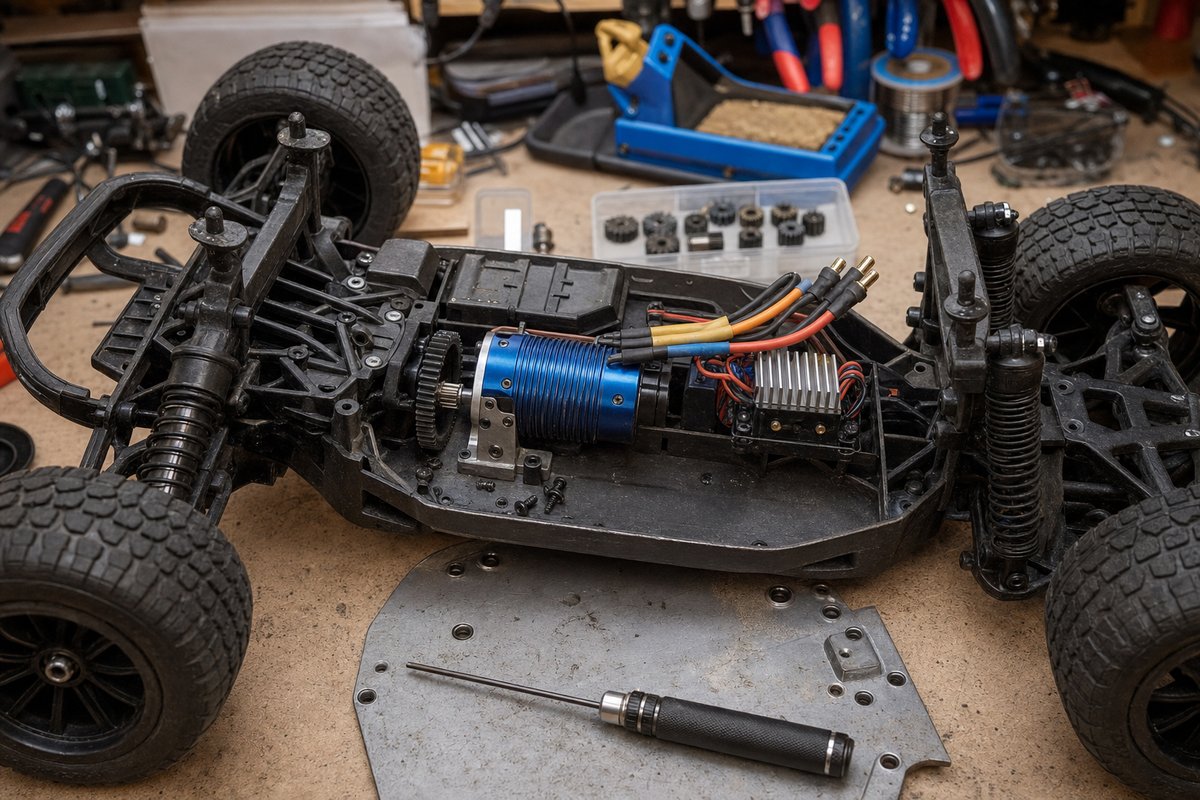
The Slash 4x4 ships from the factory with a brushed 550-size motor and a brushed-only ESC, a pairing built for durability and a controlled price point rather than outright performance. Brushed motors rely on physical carbon brushes riding against a commutator, and that mechanical contact both wastes energy as friction and wears the brushes down over time until they need replacing. The stock ESC is sized to match, with enough continuous amperage for the stock motor's draw and very little spare headroom left over for a hotter setup.
That headroom problem, more than the motor's raw output, is usually what limits a stock Slash 4x4. Push a brushed system hard on a warm day and the ESC often hits thermal cutback well before the motor itself gives out, cutting power mid-run rather than risking real damage. Swapping in a sensored brushless motor and a brushless-capable ESC removes both bottlenecks in one step, trading the brushes' friction losses for higher efficiency and giving the electronics enough continuous-amp ceiling that thermal cutback stops being the limiting factor during normal driving.
Brushless Conversion Basics for the Slash 4x4
A Traxxas Slash 4x4 brushless motor upgrade replaces the stock 550-size brushed can and brushed-only ESC with a sensored brushless motor and a brushless-capable ESC in one matched combo, rather than swapping the motor alone and hoping the stock ESC keeps up. Sensored brushless motors use small Hall-effect sensors inside the can to tell the ESC exactly where the rotor sits at low RPM, which gives smoother, more controllable low-speed throttle response than a sensorless motor provides. Sensorless brushless motors skip that wiring and estimate rotor position electronically instead, which works fine at speed but can feel jerky from a dead stop, a real downside for technical driving or crawling sections mixed into a bash session.
Most Slash-specific combos sold as a matched motor-and-ESC pair are sensored for exactly that reason. The mounting bolt pattern and pinion gear interface on a brushless can are the same as the stock brushed motor's, so no chassis modification is needed; the swap is a matter of unbolting the old motor, bolting in the new one, setting mesh on the new pinion, and wiring the ESC's three phase leads and sensor cable, if sensored, into the corresponding motor connections. The connector on the battery side matters here too. A higher-power brushless combo draws more continuous and peak current than the stock brushed system, and pushing that current through an undersized connector is its own failure point; the XT60 vs XT90 connector comparison covers when a stock XT60 pack still has enough headroom and when it is worth stepping up.
Motor KV Selection by Gearing and Battery Cell Count
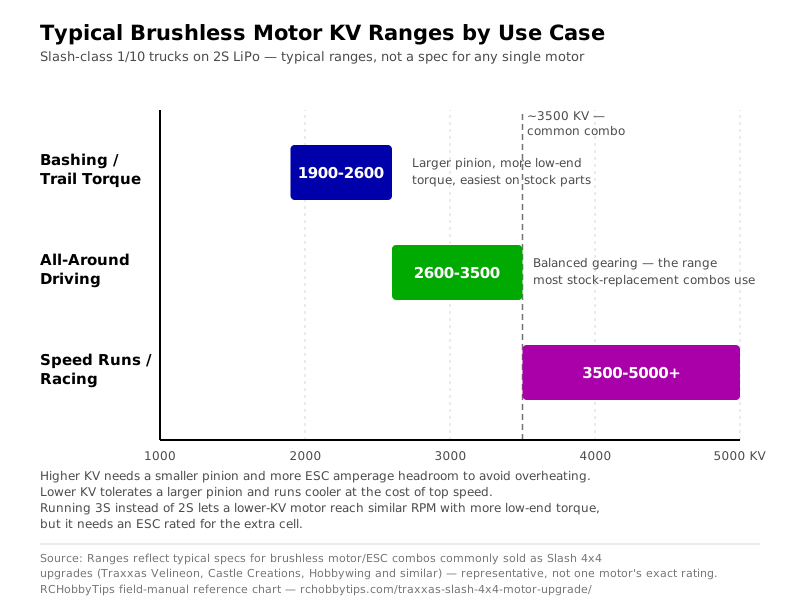
KV describes how many RPM a brushless motor spins per volt with no load, and it is the single number that determines how a given motor and gearing combination will feel more than any other spec on the box. A lower-KV motor spins slower per volt but produces more torque at the wheels for a given pinion size, which is why bashing- and trail-oriented builds usually run at the low end of the typical range. A higher-KV motor spins much faster per volt and needs a smaller pinion, or a larger spur, to keep the final drive ratio in a sane range, which is the setup dedicated speed builds reach for.
The chart below groups typical KV ranges by how a Slash-class 1/10 truck actually gets driven, on a 2S pack in each case. These are typical ranges reflected across the motor and ESC combos commonly sold for this platform, not an exact spec for any single motor.
Embed this chart
Gearing and KV work together, not separately. Moving to a higher-KV motor without also stepping down the pinion, or up on the spur, pushes RPM and heat higher than the motor and ESC were designed to sustain, even if the KV number alone looks reasonable on paper. Cell count changes the equation as well: running 3S instead of 2S multiplies the same motor's effective RPM by roughly 1.5x, so a lower-KV motor on 3S can reach similar top-end RPM to a higher-KV motor on 2S, with more usable low-end torque and less heat stress on the windings, provided the ESC and connectors are rated for the extra cell.
Check pinion mesh with a strip of paper before the first hard run after any motor swap. Too tight a mesh cooks the pinion and spur teeth fast; too loose and it strips under load the first time the throttle gets buried.
ESC Pairing and Amperage Headroom
An ESC's continuous amperage rating needs real headroom above the motor's actual draw, not just a rating that happens to be higher on paper. A workable rule of thumb is sizing the ESC's continuous rating at least 20-30% above the motor's expected peak continuous draw for the intended use case, since real-world draw during hard acceleration and wheelspin runs higher than a motor's datasheet numbers suggest under ideal conditions. An ESC running right at its rated ceiling with no margin left is the setup most likely to hit thermal cutback on a hot day or during a long bash session.
Waterproofing matters just as much as amperage for a Slash 4x4, since the truck routinely gets run through puddles, wet grass and light rain. A brushless ESC rated for wet conditions, with a sealed housing and a properly gasketed lid, avoids one of the most common failure modes reported for brushless upgrades on this platform: water intrusion frying an unsealed ESC. Heat sinking is the other half of the equation; mounting the ESC where airflow actually reaches it, rather than tucked against a battery tray or wiring harness, keeps the extra amperage headroom from being wasted on a component that overheats anyway.
The Best Traxxas Slash 4x4 Motor Upgrades by Use Case
There is no single best motor for Traxxas Slash 4x4 trucks across every driving style; the right pick depends on whether the truck spends most of its life bashing, all-around driving or chasing top speed. The Traxxas Slash 4x4 motor upgrades below are grouped by that real-world use pattern rather than by price alone, since the cheapest combo and the fastest combo are rarely the same one.
For bashing and trail driving, a lower-KV motor in the typical bashing range, paired with an ESC that has generous amperage headroom and a larger pinion for torque, holds up best to repeated hard hits, loose dirt and stop-and-go throttle. This setup runs cooler than a speed-oriented combo and puts less strain on the stock diffs and driveshafts, though upgrading to stiffer aftermarket shocks for the Slash 4x4 is worth doing at the same time, since the added torque compresses stock shocks harder on landings than the brushed motor ever did.
For all-around daily driving, the mid-range KV band most stock-replacement combos ship in strikes the best balance of top speed, torque and heat margin without needing anything beyond a matched ESC and a reasonable pinion change. This is the setup most Slash 4x4 owners land on, and it is a comfortable match for the stock diffs and driveshafts as long as the gearing stays within the ESC and motor's rated range.
For dedicated speed runs, a higher-KV motor with a smaller pinion, run on a battery pack with enough continuous discharge rating to feed it, delivers the top-end numbers this platform is known for, but it demands the most from every other part of the drivetrain. A speed-focused build needs a waterproof ESC with real amperage headroom, upgraded driveshafts rated for the higher RPM, and a LiPo pack sized and rated for the extra continuous and burst current the higher-KV motor pulls. Anyone stepping up from a 2WD Slash for this kind of build should also compare notes against the 2WD Slash upgrade path, since that platform hits many of the same gearing and ESC decisions with a lighter chassis and different weight distribution.
Common Traxxas Slash 4x4 Motor Upgrade Mistakes
Rushing a Traxxas Slash 4x4 brushless motor upgrade without upgrading the diff gears and driveshafts at the same time is the single most common way to turn a fun power increase into a stripped gear set or a snapped shaft within the first few runs. The stock drivetrain is built around the output of a brushed 550 motor, and even a modest brushless swap can exceed that ceiling by a wide margin, especially paired with aggressive throttle habits.
Undersizing the ESC's amperage headroom is the second most common mistake, usually from picking an ESC rated just above the motor's nameplate draw rather than leaving real margin for hard acceleration spikes. A close call on paper becomes a thermal shutdown on the trail the first time the truck gets driven hard on a warm afternoon. Gearing mistakes round out the list: jumping straight to an aggressive pinion for maximum top speed without checking motor and ESC temperature after a run invites the same overheating problem from a different direction, since too small a pinion for the chosen KV multiplies RPM and heat rather than just adding speed.
Cost Tiers for a Traxxas Slash 4x4 Brushless Motor Upgrade
Budgeting for Traxxas Slash 4x4 motor upgrades comes down to three realistic cost tiers, and knowing which tier a build actually needs before shopping avoids paying for headroom that never gets used, or underspending on an ESC that cooks itself the first hot weekend.
| Tier | What's Included | Best Suited For |
|---|---|---|
| Budget combo | Entry-level sensored motor and matched ESC sold as a single kit, stock gearing retained | First brushless swap, casual bashing |
| Mid-range combo | Branded waterproof motor and ESC combo, upgraded pinion/spur set, basic heat sinking | All-around daily driving |
| High-performance combo | High-KV motor and high-amp waterproof ESC, upgraded driveshafts and diff gears, matched high-discharge battery | Dedicated speed runs |
The jump between tiers is rarely just the motor and ESC price. A high-performance build also needs the supporting drivetrain and battery upgrades covered earlier in this guide, and skipping those to save money on the initial combo is how a promising speed build ends up back on the bench with a stripped diff a few runs in.
Matching Motor, Gearing and ESC: A Quick-Reference Guide
Pulling every decision in this guide into one pass: start with how the truck actually gets driven, pick a KV range from the chart above that matches that use case, size the ESC's continuous amperage with real headroom above the motor's expected draw, and confirm the pinion and spur combination keeps RPM inside both the motor and ESC's rated range. Use the quick-reference guide above alongside the cost tiers to land on a combo that matches the budget without leaving the ESC or drivetrain undersized for what the new motor can actually deliver.
Browse the rest of the Cars & Trucks section for shock, gearing and battery guides that pair with this upgrade, since a brushless motor swap rarely stays an isolated change once the truck is noticeably faster than it was on the stock 550.
Frequently Asked Questions
Is a Traxxas Slash 4x4 brushless motor upgrade worth it?
For anyone driving the truck regularly, yes. A matched brushless motor and ESC combo adds real top speed and run time over the stock brushed system, and modern combos sold specifically for this platform make the swap straightforward, though it is worth budgeting for upgraded diff gears and driveshafts at the same time rather than treating the motor as an isolated change.
What's the best motor for Traxxas Slash 4x4 trucks?
The best motor for Traxxas Slash 4x4 platforms depends on how the truck gets driven: a lower-KV motor suits bashing and trail use, a mid-range KV suits all-around daily driving, and a higher-KV motor suits dedicated speed runs, each paired with an ESC that has real amperage headroom for that use case.
What KV motor should I run in a Traxxas Slash 4x4?
Most bashing-focused builds land in the lower part of the typical KV range, all-around driving sits in the middle, and dedicated speed builds move to the higher end, always checked against the ESC's rated amperage and the pinion/spur combination actually installed.
Do I need a new ESC when I upgrade the motor?
Yes, in almost every case. A stock brushed ESC cannot drive a brushless motor at all, since brushless motors need three-phase electronic commutation the stock ESC was never built to provide, so the motor and ESC get replaced together as a matched combo rather than swapped one at a time.
How much amperage headroom should the ESC have?
A workable rule of thumb is sizing the ESC's continuous rating at least 20-30% above the motor's expected peak continuous draw for the intended use case, since real driving conditions push current higher than a motor's datasheet numbers under ideal test conditions.
What pinion and spur gear ratio works with a higher-KV motor?
A higher-KV motor generally needs a smaller pinion, or a larger spur, than a lower-KV motor to keep the final drive ratio, and the resulting RPM and heat, inside a range the motor and ESC can sustain, so gearing changes should always follow a KV change rather than staying on the old ratio.
Will a brushless upgrade damage the stock diffs and driveshafts?
It can, if the added torque and speed go in without any supporting upgrades. The stock drivetrain is built around a brushed 550 motor's output, and even a modest brushless swap can exceed that ceiling, so upgraded diff gears and driveshafts are worth budgeting for alongside the motor and ESC rather than after something breaks.
Can I run 3S LiPo after a brushless motor upgrade?
Only if the motor, ESC and connectors are all rated for 3S. Running 3S instead of 2S raises effective RPM and current draw significantly, and pushing a 2S-rated combo to 3S is a common way to burn out an ESC or overheat a motor that was never spec'd for the extra cell.
How much faster does a Traxxas Slash 4x4 get with a brushless upgrade?
It varies by KV and gearing, but a well-matched brushless swap on a Slash-class truck commonly adds somewhere in the range of 15-25 mph over the stock brushed setup, with the top end of that range reserved for dedicated speed-run gearing and a matched high-discharge battery.
What's the cheapest way to upgrade the Slash 4x4's motor?
A budget sensored motor and ESC sold as a single matched kit, run on the stock gearing, is the lowest-cost entry point into a brushless upgrade, and it is a reasonable place to start before committing to the driveshaft, diff and battery upgrades a higher-performance build eventually needs.
Do I need to upgrade the battery connector when I go brushless?
Sometimes. A higher-power brushless combo can draw more continuous and peak current than the stock connector was rated for, and running that current through an undersized connector is its own failure point, so checking the connector's rated amperage against the new combo's draw is worth doing before the first hard run.
Does a brushless upgrade void the Traxxas warranty?
Yes, in most cases. Installing a non-Traxxas motor, ESC or other electronic component typically voids the manufacturer's warranty on the drivetrain and electronics, since Traxxas can't validate a third-party combo against factory tolerances. Anyone still under warranty and worried about future coverage should weigh that against the performance gain before swapping components.
Can I reuse the stock pinion gear after a brushless motor swap?
Only if the new motor's shaft diameter matches the stock motor's shaft diameter exactly, which isn't guaranteed even among motors marketed as direct Slash 4x4 replacements. Most brushless conversion kits ship with a correctly sized pinion or specify the required bore, and reusing an old pinion on a mismatched shaft either won't seat or will slip under load.
How do I know if my ESC is waterproof before running the truck through water?
Check the ESC's own specification sheet or product listing for an explicit waterproof or sealed rating rather than assuming from the housing's appearance, since some non-waterproof ESCs use a fully enclosed case that looks sealed but isn't gasketed at the wire entries or lid seams. Running a non-waterproof ESC through puddles or wet grass is one of the more common ways a fresh brushless upgrade fails within its first few outings.
Is a sensored or sensorless brushless motor better for a Slash 4x4?
Sensored is the better default for this platform, since the Hall-effect sensors give smoother, more predictable throttle response from a dead stop, which matters for technical driving and tight maneuvering as much as it does for straight-line bashing. Sensorless setups can work fine at speed but tend to feel jerkier at low throttle, a real downside on a truck that regularly starts and stops.